In the opening days of the Korean War, the United States sent the venerable B-29 to bomb targets in North Korea during the day. The B-29 was not the biggest stick in our tool box, but the powers that were decided it was big enough. It was armed with up to ten .50 caliber machine guns as defense against fighters. It should have been enough against a small country like Korea, which had been occupied by the Japanese during WWII.
We didn’t count on the help offered to the North Koreans by the Soviets, however. The new MiG-15, a jet of similar capabilities to our own F-86, was sent from the Soviet Union to help the North Koreans. These jets tore our beloved B-29s to pieces in the few daylight raids they made. The gun turrets on the B-29 were designed in WWII when aircraft MIGHT be expected to reach speeds of four or, on a good day with a tail wind, five hundred miles per hour. The turrets could not turn fast enough to keep up with the Soviet fighters.
So we sent fighter escorts. We did not even have our best fighters over there at first. Our shiny new Saber Jets were sitting on alert, waiting to shoot down Soviet Bombers we KNEW were coming, back at home. So, the P-51 and the F-4U and the F-80 had to make do with attempting to defend the bombers. They eventually sent the bombers at night. That helped.
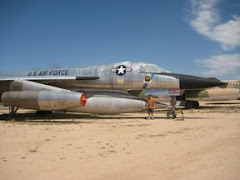
The B-36, the unheralded GIANT of the Cold War, was designed to fly great distances to another continent to deliver huge payloads. It had six piston engines that would drive it along at high altitude at a ground speed of somewhat less than three hundred miles an hour. As the 1950s began, it became obvious that such a slow bomber might be vulnerable to the new jets. They had the B-29 as proof. Many ideas were floated concerning how to protect the huge bombers.
They ended up putting jet pods on the B-36 to give it a better dash capability. With the extra engines came the apt phrase, “Six turning and four burning.” The B-36s defensive armament consisted of 20 mm machine gun turrets situated around the aircraft stowed in gun wells and faired over when not in use. When the need arose, the doors slid aside and the turrets folded out and then tracked the target.
Still, it was felt they needed something else to get them safely into and out of Soviet air space. Jet fighters of the era could not fly the long distances that the bombers were capable of flying. They finally hit upon taking their own fighter cover with them. The B-36 was so big they figured it would not be very hard to put a small fighter in a bomb bay and launch the fighter when in enemy air space to defend the bomber. When the threat was gone, it would come back and link up with its parent aircraft and head for home. The bombers WOULD get through! Or that was the intent.
It was called FICON, or FIghter CONveyor. The Air Force had developed a midget fighter to do the job. Basically the pilot was riding a jet engine with guns and stubby wings. The XF-85 Goblin did not go into production (but you can see an example at the Air Force Museum in Dayton, Ohio). What really ended up happening was they ended up going with the F-84. Since the F-84 was NOT an even match for the MiG, the Air Force decided the pair might make a successful recon duo. (A gentleman on one of the forums mentioned also that there was a nuclear mission included in this, too. The F-84 would deliver the weapon and/or take photos and return to the mothership) They took the reconnaissance model of the F-84F thunderjet and modified it so it could hook up with a trapeze that was extended from the bomber. They had to angle the horizontal stabilizers down, though, so it would fit in the bomb bay better. The RF-84K was born.
The mothership was designated a GRB-36, the R referring to its reconnaissance capability, the same as its jet powered offspring. Instead of using this pair to bomb and fight, which may or may not have worked, FICON allowed the SPEED of a fighter to collect intelligence, but with the range of a bomber.
They became operational in 1954 and were stationed in Washington State. There were only ten GRB-36s built and there were only 25 RF-84Ks built. The GRB-36s were stationed at Fairchild AFB near Spokane. The RF-84Ks were stationed at Larson AFB near Moses Lake, Washington. The units were deactivated in 1955, so their operational life covered only a short time. The RF-84Ks went on to operate as normal parts of the recon force. Washington State was the only place these strange pairs were stationed (that we know of).

There were only 25 RF-84Ks built. From three or four remain today. Numbers #52-7256, #52-7265, and #52-7266 are in the USAF Museum, Planes of Fame Museum, and the Wings Over the Rockies Air Museum. There is some evidence that one other has survived, but I have not been able to substantiate that information. At least one RF-84K crashed. It crashed AFTER FICON operations were discontinued.
It was the Ides of March that Caesar was warned to beware of; perhaps 1st Lieutenant William Hackett should have heeded the same warning, for it was March 15th when he exited his RF-84K in an unusual way: via ejection seat.
On the morning of March 15, 1957, at Larson Air Force Base, near Moses Lake, Washington, Captain Edward R. Dixon and First Lieutenant William Maurice Hackett stepped out onto the tarmac from the operations shack to go to their respective aircraft. It was cool out, but at 45 degrees not too cold. Each went through their pre-flights and checklists. They had filed a DD Form 175, for a flight of two RF-84Ks using Instrument Flight Rules, call sign Pony 97, for a local area flight.
As they taxied out for a 1045 PST takeoff, Captain Dixon experienced radio difficulties and cancelled the IFR clearance. He told Hackett to go ahead and take off. With the intent of eventually joining Hackett, he returned for a spare aircraft. This time, in aircraft #52-7272, Dixon rendezvoused with Hackett at 1135 PST and they continued their flight.
They flew to the vicinity of the Spokane Low Frequency Radio and tried to contact Geiger AFB to practice a Ground Control Approach. This would see them follow Ground Control’s instructions to approach Geiger field. They had come around to a position East of Geiger AFB. They were going to approach runway 25 at Geiger AFB. This was not to be, though.
At about 1200 PST, Hackett felt something was wrong with his aircraft. He lost thrust. The tachometer dropped from 86% to 0% RPM. The engine flamed out. Hackett began procedures to restart. This didn’t work. He tried it with the emergency fuel system. It didn’t work. He decided to attempt a dead stick landing at Felts Field, which was closer, but at a different angle. He would have to come north to line up with the runway. Dixon flew his wing and likely made observations in an attempt to render assistance to Hackett and aid rescuers in locating him.
He realized he was too low, though, and turned away from populated areas before he ejected. The aircraft was on a northward track when it hit the bluffs above the Spokane River. Hackett’s chute took him about a half mile Southwest of his aircraft. Elvetta Phillips said it looked as though the bluff, “was exploding in a volcanic eruption.” “Bright red flames and black smoke shot several hundred feet into the air following the crash,” says the Spokane Daily Chronicle article of March 15. Phillips, a reporter for the Chronicle witnessed the crash with C. Wesley Cameron, a photographer for the Chronicle. Cameron took photos, one of which ended up in the official air force report.

A view of the smoke rising from the crash site near the Riblet House.
Royal Riblet and Al Drake saw the crash. Riblet was just outside his house. Drake was working on a pipeline at the top of the hill. Both men were about 500 feet from the crash site. Drake ran to the aircraft to attempt to find the pilot. When he found no evidence of the pilot he, “got right out of the area.” The flaming aircraft caused fires along the hill. Riblet described the crash: “The plane hit the bluff, bounced upward and seemed to explode into millions of pieces.” Local fire departments were dispatched to the scene. The explosion shook the windows of houses a mile away.
Witnesses stated that Hackett’s chute had not been open very long before he hit the ground. Hackett was rushed to Geiger AFB. He was listed as having major injuries in the accident report. Among his injuries was a sprained or dislocated left humorous and abrasions or contusions. He landed with a force estimated as similar to a drop of 16 to 20 feet. His orientation was forward and swinging. He left the aircraft when it was traveling at about 190 kts. He was wearing a P-4 helmet with the visor down. His descent was arrested by power lines. When he tried to shake himself free, the lines swung and shorted out, burning through the canopy. This caused a power outage in the Milwood and Opportunity areas for about 45 minutes.
#52-7278 was the last RF-84K built. It was accepted by the Air Force on November 30, 1955. Given that operations of RF-84Ks and GRB-36s were discontinued late in 1955, it seems unlikely that #7278 ever actually mated with a GRB-36 in flight. The airframe had 231 hours on it. The Engine, a J-65, had 216 hours on it. It had last been installed and inspected only nine hours run time previously. Though it had never been overhauled, it was considered a new engine. Hackett had flown with the engine stabilized at 86% for twenty minutes before it flamed out. The engine and other parts were recovered and sent to MAAMA (Middletown Air Material Area) for testing. The results are unknown.
When F-84s first became operational, the engines were overhauled at much shorter intervals. As operations progressed so did the operational parameters of the engines. What caused the flameout? Was it hardware related? Was it fuel related? Other reports I possess have had laboratory results giving the properties of the fuel. This report does not. Until I find information that says one way or another, I am forced to admit I do not know.
The RF-84K was a relic of a time when jet aircraft had short ranges that needed to be extended to become successful in combat operations. The F-84 was used in Korea, but Korea was a small country. What if you want to bomb targets in Soviet Russia? Or take photos? You need the extra range. The FICON project was an ingenuous solution to this problem. It was not the only solution, though. Eventually, in-flight refueling became an everyday occurrence; extending aircraft ranges the world over. The Lockheed U-2 had a tremendous unrefueled range, due in part to its phenomenal design and ability to fly at the edge of the atmosphere where the air does not cause as much drag.
The FICON project has a unique place in the History of Flight. The fact that the operational units involved were based in Washington State is something that is worthy of note!
Curious about the RF-84K? Or other things mentioned here? Checkout some of my sources:
Wings Over The Rockies Museum
Air Force Museum
Short mention of recon use
A nice article on FICON
Planes of Fame Photos of 7265
Spokane Daily Chronicle
USAF Accident Report for #52-7278.




 Posts


