A fellow wreck chasing enthusiast and I visited the site of #44-23914 just over a year ago. I was amazed at how much, and yet, how little, remained. The forces that are at play in an aircraft crash are phenomenal! The majority of the pieces we saw bespoke a horrible and violent end. There were pieces of aluminum that had been fold like an accordion. Others were simply misshapen to the extent that their original form was unrecognizable.
My friend, Mr. Gould, obtained the accident report for #44-23914 and furnished me with a copy. I now present the small amount of information contained therein along with some other components that will fill out the story. Unfortunately, the report leaves more questions than it answers.
The day was September 30, 1944. A few days earlier and about 20 miles to the south, the super-secret Uranium pile of the B-Reactor, part of the Manhattan Project, had gone critical for the first time. Further away, men of the US and its allies in Europe had just taken part in in the ill-fated Operation Market Garden and were withdrawing to lick their wounds. The situation in the Pacific was looking up, soon our forces would be gathering for another invasion, this time on the Philippine Islands. The small town of Othello a few miles away was quiet, except for the freight trains bearing war materials every now and then. The wind was moving at a leisurely 9 miles per hour. There were a few clouds above the valley floor. The farm land did not show the scars of war, yet. That would change this afternoon.
There were several Army Air Fields near by. Moses Lake Army Air Field was the closest. The fighters from that base would be training throughout the day over the farmland of Eastern Washington. The fast Lockheed fighter was the one that was seen most. It could be seen in flights of four, most days. The pilots would be going through the various training missions. From navigation, to bombing, to dogfights and low level flight.
The P-38 Lightning was recognizable because of its unique shape. Instead of the normal cross shape of most aircraft, the P-38 looked a lot like two T's written close together and attached at the bottom. It had two engines and was a great fighter as long as the pilot did not mistreat it. A training film of the era cautioned against inverted flight for any length of time, as the oil pressure would drop dramatically and ruin the bearings in the engines. It also stated that if you needed to recover the aircraft in a downward maneuver, you needed to have at least 10,000 feet altitude.
On this particular day, at 12:55PM, yet another flight of P-38s had left Moses Lake Army Air Field. These four proceeded to a local gunnery range for a sighter burst and then climbed to 12,000ft. for a syllabus of "supervised acrobatics" and individual combat. (the number three man, 2nd Lt. James B. Keller, and number four man,2nd Lt. John W, Eveland, both stated that they were actually at 7000-8000, this difference in stated altitudes is interesting. The leader, 1st Lt. Charles N. Fagan, stated that the cloud bases were at 7000-8000 feet and the cloud tops at 11,000. Could this be a mix up?)
The leader strung his formation out in "String Formation." and began to "rat race" around the cloud tops. This would appear to be simply a game of follow the leader. At one point, about 1:30PM, according to all flight members, the formation passed into the top of a cloud or through a wisp cloud (again, they differ). The flight members all stated that they were only in the cloud for one to two seconds at most. They did not even switch to instruments. When they entered the cloud, the number two man was there where he belonged. When they came out he was gone.
The number two man was Flying Officer Gene L. Dyer, apparently of Australia. He was flying P-38L #44-23914. There were no problems listed concerning the aircraft, save for the left oil shutter which was left in automatic. Dyer simply disappeared from the flight. A BT-13 pilot, 2nd Lt. Morris D. English, flying in the general area witnessed a P-38 in a spin at about 1:20PM, it came out of the bottom of a cloud at about 6500 feet and at about 5000 momentarily recovered in a nose down position. The BT-13 pilot did not see more because a cloud obscured his vision.
When he was noted as missing, his flight made radio calls to him and to Moses Lake tower. They flew around looking for the crash site. Then they headed back to the field to see what the tower knew. Lt. Fagan took another plane out and searched for Dyer. He located the wreck and guided the crash truck and ambulance to the site.
The majority of the aircraft was recovered. What remains today are just small pieces. Some of the cylinder housings from the engines, various hydraulic fittings and hoses, and even the side of a Browning Mk. 2 .50 caliber machine gun. There is just a crater or impact scar that marks the place where Gene L. Dyer died. There is no other marker.
What happened? Is it possible for things to go so completely wrong in 1-2 seconds that you cannot even call for help in your plummet to the ground? Given the characteristics of the P-38, and the eye-witness report from the BT-13 pilot, it seems that Dyer somehow got himself into a spin and may have been recovering. The ground level at the crash site is about 1000 feet above sea level. If the flight was at 12,000 feet, it seems completely possible that Dyer had plenty of room to recover. However, if the two other members of the flight were indeed correct when they stated that the flight was at 7000 to 8000 feet, it seems Dyer was just too low to recover completely from the spin.
Is it possible that the three members of his flight were covering for each other when perhaps they had been doing maneuvers that were not permitted? I do not know. I only bring it up because of the amazingly short amount of time that he was out of sight and the conflicting reports, which do not seem to have been questioned by anyone. Even though I am aware that accidents can happen very fast, the report just seems to be missing something. I suppose we will never know for sure.
Sources:
USAF accident report for #44-23914
Personal observations of wreck site, March 14, 2009.
http://www.othellowashington.us/
YouTube, WWII era training film.
http://www.youtube.com/watch?v=pDmIB7u18_0
Showing posts with label crash. Show all posts
Showing posts with label crash. Show all posts
Sunday, April 25, 2010


Friday, August 14, 2009
August 15, 1945
A couple months ago, I acquired this newspaper. most fascinating, isn't it?


Sixty-four years ago, this is what was in our local newspaper. Note the sinking of the Indinapolis was no small story. Still, in the lower part of the page is a story that is of interest to me and you and anyone else tht reads this site. See, to the lower left? Where it says "Navy Flier Dies In Valley Crash?"

Now, I am still awaiting the accident report from the Navy, but they are, apparently, in the midst of a move and it may be awhile before the files I have requested can be sent to me. Still, it is an interesting find, don't you think?
Sunday, May 10, 2009
F-104C #57-912, May 10, 1963

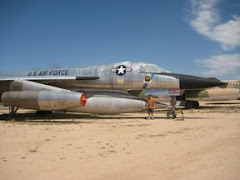
(the F-104D at McClellan Aviation Museum, now Aerospace Museum of California)
On May 10, 1963, (46 years ago today) Captain Victor J. O'Bryan strapped on an F-104C Starfighter for a Napalm and Strafe mission at the Yakima Firing Center. O'Bryan was part of a vast aerial armada that had been moved to the central part of Washington State for Exercise Coulee Crest. This exercise was designed to test the smooth cooperation of the different service branches. Captain O'Bryan was part of the 479th Tacticl Fighter Wing, and the 435th Tactical Fighter Squadron from George AFB. His aircraft would not last the day.
The mission was to rendezvous with an F-100F over the range in Central Washington and have the flight photographed on it's firing passes which would be coordinated by a Forward Air Controller (FAC). Weather was 4000 scattered, high thin scattered, visibilty was 15 miles and the temperature was 60 F. The wind was five miles an hour. The flight consisted of 4 F-104C Starfighters, made by Lockheed for the Tactical Air Command. O'Bryan was the number three man.

Why a thoroughbred fighter plane like the F-104 should be forced to carry bombs and troll around in the mud is beyond me. The F-104 did one thing very well. It went very fast. It was tiny. The cockpit is not far above the ground, in a pinch you could probably get into the cockpit without the benefit of a ladder. It was about 54 feet long with a miniscule wingspan of only 21 feet. Those wings had sharp edges and had special covers so ground crews would not injur themselves while walking around the plane (See photo below). It was difficult to find in the sky and it was very fast. It had one very powerful engine, the J-79, also used on the F-4 Phantom. The C model of the F-104 had a new model of the J-79, its diameter was three inches bigger, giving it about 1000 more pounds of thrust. However, "The F-104C had a number of operational problems with various components. The major offender was the J79-GE-7 engine--forty serious mishaps occurred over a five-year period, destroying 24 aircraft and killing 9 pilots. This led to Project Seven Up, a General Electric modification program for the engine which began in May of 1963 and ended in June of 1964. "* Still, the F-104 could deliver its small payload with devestating accuracy according to most sources.

The flight's call sign was Ritzy. The preflight had stressed safety procedures concerning the armament. The report states that the armorer noted nothing out of the ordinairy during the arming of the gun. Even another pilot from the flight had checked his gun door and felt that it was secure.
The flight took off at 1005 PDT and proceeded to the target area where they contacted Friend X-ray, their FAC. The F-100, call sign Boil 64, joined the formation on the wing of number four at this time. The FAC directed the flight to the target, 55 gallon drums and cardboard troop cut outs. The flight dropped its napalm on the first pass. They then went around for a gunnery pass. O'Bryan did not fire on the first pass because of the smoke from the napalm. At this time, Boil 64 lost his position on the number four aircraft and formed up on O'Bryan's wing for his second strafing pass. At about 2500 feet from the target, O'Bryan opened fire. He had only fired about 100 rounds when he felt a jolt in the aircraft and heard a grinding noise as the gun stopped firing.
O'Bryan interpreted this as a gun jam and initiated a pull up at 100% power when Boil 64 told him a part of his aircraft had just come off. O'Bryan asked him to check out his aircraft and left his power at 100%. Boil 64 indicated that O'Bryan's gunbay door was missing. There was also a hole at the bottom rear of the gun compartment, at this time, O'Bryan began to notice the engine running rugged. His instruments read 700 degrees EGT (Exhaust Gas Temperature), 70% RPM. The aircraft peaked out of the climb at 6000 feet and 240KIAS (Knots Indicated Air Speed) and began a gentle descent. O'Bryan attempted a low-altitude stall clearing procedure. While he was doing this Boil 64 could not slow down enough to stay with him. The procedure worked and RPM increased to 90%, but then the engine stalled again, but more violently than before. His altitude was 4000 and O'Bryan decided it was best to leave the aircraft. He leveled out at 200KIAS. His radio had not come back on line after the stall clearing procedure.
He jettisoned the canopy, and ejected successfully. Pilot and seat separated, but the automatic chute opening system malfunctioned and he had to pull the manual lanyard. He landed safely and was picked up by helicopter within a half hour. The aircraft impacted approximately 14 miles NE of Yakima, Washington. The price of the aircraft is listed as $1,478,402.00.
.
It would appear from the report that there was an explosion of gun exhaust gas, which compromised the gun bay door. It would appear, also, that parts from this explosion were possibly ingested by the engine, which caused the stall. Given the F-104's poor slow speed handling and the fact that it had the glide angle of a brick with wings, it was probably a good idea to depart the aircraft.
below are pictures of the engine. It appears to have wrapped itself up.


here is a map of the crash area.


here is a map of the crash area.

Saturday, May 2, 2009
Pasco F-106 #57-2489 *update #2*
Contiuning with the F-106 theme, I have here one that went down much closer to my home than the others. Still, as with the other F-106 reports, it leaves much to be desired. This report has only 2 pages plus a map and a photo.
On Tuesday, March 19, 1963, (at about 1712Z or zulu, which would be 9:12am local, because PST is Zulu -8) an F-106 on a local training mission came down about 5 miles south of Pasco, Washington. Its pilot had reported control problems.
Earlier that morning, Captain William F. Tesmer and Lieutenant Donld L. Hatcher briefed for a local training mission. Expected takeoff time was 1615Z, however, their flight was scrambled early at 1557Z(7:57am local). Tesmer's callsign for the mission was AH06 and Hatcher's was AH05. At this time, AH06 reported "dolly in valid." This phrase is not familiar, so could be reference to some ground control point with that call sign, or perhaps he was reporting that his automated guidance/data link was faulty. The latter seems to be supported, though: Three voice intercepts were completed against SAC target Y209 (Again, probably a B-52 from a local base). The results were three "MA's" (Mission Accomplished?) for three attempts. AH05 then completed two data link passes. The first pairing for AH06 was at 1612Z and the last was at 1647Z. The last intercept was completed about 200NM southwest of Geiger Field.
At this time AH05 had 4800 pounds of fuel and AH06 had 6400. AH05 had gone supersonic, which acounted for the difference. Both were returning to base (RTB) at Geiger. AH06 was 12 miles in trail of AH05 at 40,000 feet. AH06 called tallyho on AH05 (meaning he had picked him up visually) and said he would make a pass on AH05 on the way back to Geiger. At 1657Z AH06 transmitted MAYDAY at GEORFF position DRQA5049. (I would sure love to know how this navigation system works)
AH05 stated that, to his knowledge, AH06's intercepts had been completely normal until his breakaway maneuver had begun. AH06 overtook AH06 on the starboard side "began a medium back turn to the left, passing directly overhead." Ah06 transmitted that his "flight controls are frozen" and requested that AH05 follow him. At this time AH05 estimated AH06's mach to be 1.3 or 1.4. AH06 suggested that his "vari-ramps have possibly not returned to their normal position" and "'there is no light on' (vari-ramp), indicating that he was at a supersonic speed sufficient to actuate the vari-ramps." (the vari-ramps would appear to be the F-106 version of a variable inlet. As airspeed increases, engineers have found that it is desirable to alter the flow of air into a jet engine to keep the incoming air subsonic, despite the speed of the aircraft. This is usually done by changing the inlet shape or placing baffles in the inlet. Different designers found different ways of doing the same thing, for example, on the SR-71, there was a movable cone that went forward or aft in front of the engine, according to the airspeed. for more information see this NASA site.)
AH05 observed AH06 perform two tight barrel rolls to the left and then stabilize into a shallow left turn. AH05 joined AH06 for the completion of a 360 degree turn. AH06 had descended from 40,000 feet to about 33,000 feet. At 29,000 feet AH05 lost visual contact with AH06 in the clouds. During the 360 degree turn, AH06 reported that "it fees as though it's stuck in flight mode; the trim button has no effect; I can only maintain 160-170 knots." After he entered the cloud deck, there is no more transcripts of the pilot's transmissions on this report, though, apparently, the "Tab U transcript" has more.
Captain Tesmer reported that he was ejecting at 1712Z. The crash occured sometime between 1712Z and 1719Z. Eye witnesses stated that the aircraft passed the east edge of Pasco on a SSE heading at about 1000 feet altitude. They observed the aircraft pull up as it approached rising terrain south of Kennewick, Washington. As it pulled up, an object, probably the canopy, came off the aircraft. "A few seconds later they observed a bright flash, smoke, dust, and heard a loud muffled explosion."
The accident was fatal for Captain Tesmer, though there are no details explaining how. It does not say where the body/ejection seat was found, nor does it offer any other details tht would flesh out this story.
The map appears to show the impact somewhere near Jump Off Joe, a peak of 2200 feet. Not too far from the Nine Canyon Wind Project. The photo shows the crash to be on plowed land. It seems unlikely, however, that there would be any remnants after 45 years of tillings.
The flight path shows the two aircraft came from the west over the Horse Heaen Hills, about half way between the Yakima Valley and the Columbia River. Tesmer is shown as descending to 28,000 feet above Badger, Washington. A few miles later, almost over the impact area, contact was lost with him at 16,000 feet. From here it seems he made a wide descending turn to the left to end up where he did. It would seem to me that Captain Tesmer could have jumped out earlier, but he chose to ride his mount and keep it under control as best he could. Was this to find a spot to land this high speed aircraft with a high landing speed(unlikely)? Or was this to make sure his aircraft did not come down on a populated area? It seems doubtful we will ever know for sure.
Additionally, it is interesting that F-106 #57-2489 is shown in at least one source as going down some 30 miles further to the south near Hermiston, Oregon instead of its official USAF position on the same date.
*UPDATES* (Many thanks to Gene Gould for his time in the local library) Here is some added information.
1. The crater left by the aircraft was about 20X30 feet and 6 feet deep.
2. The pilot, Tesmer, was a graduate of Ohio University.
3. He served 3 1/2 years in Japan before transfer to Geiger.
4. He was survived by his wife and two children(ages 1 and 4). His parents, too lost a son, they lived in Shaker Heights, Ohio.
5. Tesmer, according to the paper, did NOT eject. While the report did not say that he did, it did not say he did NOT eject. The popping of the canopy seemed to indicate he had, though, and given early F-106 dificulties with the ejection seat, I had wrongly assumed it was to be blamed.
6. The paper confirmed the assumption that Tesmer had likely stayed with the aircraft to avoid populated areas.
*UPDATE # 2*
After some emails and a little patience, a fuller story has come to be revealed. these are the additional details:
1. The aircraft appeared to strike the ground nearly vertically.
2. Despite the fact that the canopy was found about 2 1/2 miles NNW of the crash site, the pilot's "body had remained with the aircraft upon impact." The report blamed a malfunction of the seat as most likely. The F-106 had ejection seat difficulties early on.
3. Preliminary results indicated the there had been a loss of control or near loss of control.
4. The aircraft struck at a high speed or a high thrust, given the depth of the hole.
5. The remains of the aircraft were sifted through a screen and layed out in a hangar at Spokane Airport. the report basically suggests that all remnants were removed.
6. The report further suggests that maintenance forms and records were not kept.
7. The committee suggested that a steering/control problem had occured.
While this does not say much more than the library article and the original accident report, it does add a little to what we know. Hopefully this is the last update necessary, however, if you have any personal relation to the airplane, please leave a comment or drop me an email.
Sunday, April 26, 2009
F-106 Troubles 1, #57-2484

I recently obtained a few F-106 accident reports from the early 1960s. These F-106s were assigned to the Spokane International Airport.
During the Cold War, and today, really, fighter squadrons were and are stationed around the United States with the intention that they would be able to intercept incoming bombers or other threats. The F-106s (retired in 1988) were assigned to the ADC, or Air Defense Command. The reports are not complete, in that little mention is made of blame or final solution. With that in mind, I am offering my best interpretations. If someone out there finds my suppositions to be false or you have a better description, by all means please e-mail me and I will make necessary corrections. Here is the first report.
On the morning of September 14, 1961, First Lieutenant Russell C. Wood briefed for a routine target mission. This would likely have been an intercept of a B-52 training in the area. Given the location of SAC bases, the B-52 could have been from Larson AFB, Fairchild AFB, or any number of other bases in the Northwest (Idaho, Montanna...etc.). It could have also been an intercept of an EB-57 , which was used to test the Air Defenses of the Continental US, though, I believe that to be unlikely. From what I understand the EB-57s were used for training and checking the radar systems and operators, not necessarily the ADC fighters.
Airman second class Kenneth D. Hintz accompanied Wood on his walk around of F-106A #57-2484. There were no discrepancies and Hintz secured the access panels while Wood strapped in. One combustion start was attempted with no success, but a pneumatic start worked at 0915. The MA-1 power system timed in and they made various checks, then Wood taxied to the ramp. He was airborne a 0926, 6 minutes after the proposed time. Estimated fuel onboard was 8900 pounds.
.
Wood made a left turn out of traffic and began his climb on a heading of 326. The proposed flight plan was "Geiger direct 52 degrees N. 122 degrees W. (William's Lake B.C.) direct Larson TACAN, direct Spokane VORTAC." That looks like a trip to the North East to British Columbia, a turn to the South West back to Larson, then a turn to the East to end up back at Spokane. The F-106 on the same flight profile and plan 1/2 hour behind heard his check-ins via radio, but no ground stations did.
.
It was not until he was over the Larson TACAN at 1038 at FL480 (48,000 feet) that Spokan Center heard from him. He then contacted Spokane Approach Control and was positively identified on radar (No difficult feat considering there probably were not many other aircraft at FL480) and "he was cleared to the 35 mile fix of the Spokane VORTAC, report inbound." (VORTAC stands for: VHF Omnidirectional Range/Tactical Aircraft Control)
.He reported over the fix at FL200. He was instructed to report once he passed FL70. At 24 miles he was advised of traffic, a DC-6, at 14 miles West of VORTAC. At 15 miles he was dvised to begin his landing cockpit check. He reported when he passed through 7000 feet, and requested a "surveillance approach to runway 03." He was told to level off at 4000 feet and he acknowledged. Again he was advised of traffic, and told to "prepare to start his descent in 4 miles."
.
He then told RAPCON (Radar Approach Control) that he would have to break off this approach, but they did not respond. He continued his pproach, then was told to start his descent. Twelve seconds later he was told to maintain 4000 feet and turn right to 150 because of traffic. He reported steady on 150, and then was told to turn to 205 and maintain 4000. 30 seconds later the tower observd him continue turning past 205. They asked if he was continuing this appoach on his own, to which he replied, "Negative, I would like a surveillance approach to runway 03." They told him to stop his turn and then proceeded to give him a "no-gyro" approach. At 5 miles he was told to begin his descet. Radar contact was lost at three miles, which was normal considering ground clutter.
.The aircraft crashed 2.4 miles from the runway on a heading of 063 degrees true. The smoke was observed from Spokane Tower at 1102. Wood ejected, but unsuccessfully from an altitude of 200-500 feet above the ground.
.The report ends with the summation that there was no indication of emergency from Wood. It does not state what caused the crash. It does not go into anything else. Simply the flight description. This, in the my world of aircraft accident reports, is annoying, since others generally have a page where a determination of cause is surmised if it isn't known.
.
As an unqualified observer from almost 50 years on, I offer my supposition that it may have been possible for his J-75 to flame out. I don't know what would have caused a flame-out, though. Perhaps he retarded the fuel flow for a moment or there was a stuck valve. Did he suffer a bird strike? Until the rest of the report is released or someone comes forward with a better idea, that is what we are left with.
.
The picture of the crash site and this ground track are all that is included with this report. On the map you can make out the B-52 and KC-135 shapes to the left where Fairchild is, and the F-106 and civil aircraft shapes at Spokane International.

Note: On 30 August 1956 the Air Coordinating Committee approved a common military-civil short-range air navigation system called VORTAC, which combined TACAN with the Civil Aeronautic Authority's very high frequency omnirange direction finder. see link at left.
Note: TACAN stands for Tactical Air Navigation. see wikipedia link at left.
Friday, April 17, 2009
B-52D #55-098 and KC-135 #59-1523 Meet Over Montana
During the Cold War, the men of the Strategic Air Command manned two of the three parts of the Nuclear Triad (SAC Bombers and ICBM Crews). Aircraft and crews spent a certain amount of time on Alert, that is, waiting for the klaxon to sound so they could run to their aircraft and go drop warshots on the Soviet Union. After their stint on alert, they would have some time off for crew rest, then they would be called upon to practice parts of their missions a few times a month. These would be things expected of them if they were ever called to war. If they had ever been called upon to fly to the Soviet Union, they could expect to do long range navigation, air refueling, and radar bombing, among other things. Their training, likewise, included such things.
A normal training mission might include a take off from the home base, a high altitude navigation leg, air refueling, a mock-radar bombing run, sometimes on our own cities, then a low altitude navigation leg, followed by a few pilot proficiency touch and goes. Larson AFB, just on the edge of Moses Lake, Washington, became a SAC base toward the last part of its time as an active military base. B-52s of the 327th Squadron of the 4170th Strategic Wing of the 18th Division of the 15th Air Force were stationed there. Men at Larson had the same missions as B-52 men everywhere.
In the early morning hours of December 15th, 1960, pilot Captain Thomas J. Campbell and his crew began preflight briefings which ended with a ride to the flight line and final preflight of B-52D #55-098. the ground crew would likely have been working on it since sometime around midnight. With the successful start of all eight J-57 turbojets, the bird, call sign Smite 15, taxied to the end of the runway for take off.
Departure was at 0850 PST for what was described as a "Combat Crew Training Mission." This included a rendevous with a KC-135 for inflight refueling in the "Bart's Rock High Altitude Refueling Area." This area would appear to be near the Canadian Border over North Western Montana. Refueling, in this case, would probably have been a few practice hook-ups and transfer of a minimum amount of fuel, since the B-52 had 194,000 lbs of fuel aboard at takeoff, enough for 16 hours of flight. The planned mission was for only about 8 and 1/2 hours.
Using the onboard radar suite, the Electronic Warfare Officer or the Radar Navigator made contact with KC-135 #59-1523 at a range of 60 miles. The KC-135 had flown out of McChord AFB, Washington, having departed at 0820PST. The KC-135, call sign Shore 11, had a fuel load of 126,000 lbs aboard, and, according to the DD Form 175, could have remained airborne for 10 hours.
When the range between the two aircraft was 6 miles, Smite 15 was directly behind the Shore 11. Altitude was 31,000 feet ASL. When the range had closed to 1/4 mile closure rate was determined to be excessive. Captain Campbell closed the throttles to prevent an overrun. He was not successful. The B-52 collided with the KC-135 from behind. It would appear, after examining the report photos, that the B-52 hit the flying boom and possibly the lower rear fuselage of the KC-135 with its right wing.
On board Shore 11, the boom operator established visual contact with Smite 15 at 1/2 mile. At 1/4 mile Smite 15 climbed out of the boom operator's field of vision. He cautioned Smite 15 to slow closure rate. The next visual contact the boom operator had was immediately pior to impact.
After separation and damage assessment, Smite 15 was considered to be airworthy and the crew immediately set course for Larson (Bad enough that the pilot suffered a mid-air collision, but having to land at another base surely seems like it would have lowered the pilot's chances of flying again...though this is only conjecture. It is possible, given SAC's standards, that the pilot would have suffered that fate anyway, there is no record of that in this accident report, however.). Descent, approach, and landing were normal. Near the end of the landing roll, at a speed of about 20 knots, however, disaster struck. The right wing separated from the aircraft in the vicinity of the damaged area. This separation provided fuel and ignition sources for the fire that subsequently destroyed the aircraft. All personell successfully evacuated the aircraft, though some injuries were suffered.
Shore 11 had begun its return to McChord AFB when the crew was instructed to land at Fairchild AFB. A T-33 was scrambled to do an inflight damaged assessment. Approach and landing were made without incident. All men aboard Shore 11 were uninjured by the escapade.
Here is the crew list for this mission:
B-52D #55-098
Captain Thomas J. Campbell, Instructor Pilot. (He is listed as sustaining minor injury.)
Captain Clifford L. Fonsess, Co-pilot. (Minor injury.)
Major Wayne D. Waller, Aircraft Commander. (He is listed as sustaining minor injury.)
Major David Kisong Eum, Electronic Warfre Officer. (Spelling is in question as the report is difficult to read. He is listed as sustaining major injury.)
Major Leonard Carmell, Radar Navigator.
Captain Glen M. Bird, Navigator.
Captain Robert W. Covarrubias, Navigator
First Lieutenant Basil Ciriello, Instructr Navigator (I-N is what is listed, and usually stands for Instructor Navigator, yet, given this man's rank, it would appear he was either from one of the "NEW" SAC crews or in some other way different. If someone knows for sure, I would appreciate an e-mail.)
Captain William C. Lane, Navigator. (It seems there were a lot of navigators on this ship, though the R-N was also probably the bombadier. Still if anyone has some clarification for this drop me an e-mail.)
Master Sergeant Henry W. Olschner, Gunner. (The tail gunner was physically separated from the rest of the crew on all B-52 models until the advent of the B-52G. In case of bail out, he would have jettisoned the tail turret and stepped out into space pulling his ripcord. He is listed as having sustained major injuries)
KC-135A #59-1523
Captain Warren H. Williams, Instructor Pilot.
Captain Charles L. Buechele, Pilot.
First Lieutenant Eugene A. Hendricks, Copilot.
Captain Jack W. R. Peters, Instructor Navigator.
First Lieutenant John C. Hall, Navigator.
Technical Sergeant Charles E. Cade, Instructor Boom Operator.
Staff Sergeant Martin W. Gunder, Boom Operator.
Thursday, March 12, 2009
Satus P-40, #40-309

Norm Gilman designed an engine for the Allison division of General Motors. It powered several US fighters in World War Two. It had twelve cylinders. These twelve cylinders had a dispalcement of 1,710 cubic inches. To compare that to the car I drove in high school, my Plymouth Valiant's 6 cylinder displaced 225 cubic inches. Of course, most cars these days are measured in liters. The V-1710-33 displaced 28 liters. A big Diesel engine in a Dodge truck (read Cummins)these days displaces 6.7 liters. With that many cylinders needing fuel, and the size of the cylinders, well, they took a LOT of fuel. Engine #41-35890 was such an engine, it was in the P-40 #40-309 on the fateful day of May 17, 1941.
The Curtiss P-40 Warhawk, the airplane the Army Air Forces flew as a front-line fighter at the beginning of WWII, used the Allison V-1710-33. On May 17, 1941, Captain Jasper N. Durham left Hamilton Arm Air Field in California, on a mission described as "U-5," which one can assume likely to be a cross-country orientation flight. His destination, that day, was Portland, Oregon.

(Hamilton Army Air Field, Circa 1937. Submitted by Bob Rambo to Abandoned & Little Known Airfields If you are interested in discovering Army Air Fields you never knew existed, follow this link)
About 15 miles out of Eugene, Oregon, Captain Durham was flying contact (I assume this means they were following ground features, such as roads or railroad tracks) when he encountered a large rain squall "extending for a considerable distance across the flight path. It was decided to fly over the squall and follow the beam to Portland." In order to stay in clear air, they (? there is a report by 2nd Lt. Elmer Kingen that indicates he was with the Captain) flew 20 degrees to the right or the course (On a North Westerly heading, coming right would bring the pilot East). Different courses were flown, unsuccessfully, to bring the "beam" on course, but the pilot considered that to be expected. When the estimated time of arrival had been exceeded, a break in the clouds was seen about 30 degrees to the right. He descended into the break.
When he descended he did not recognize the terrain. His fuel was "very low." He flew lower observing tracks, which he "dragged" until he flew over the railroad station in Toppenish, Washington. He was unable to find Toppenish on the map, nor was he able to find a suitable landing field. "Finally, at Satus, Washington a field was located and a normal; landing was attempted." His approach was too low and his landing gear struck the bank of the creek flowing through the field. the gear folded, damaging the wing stubs and the propeller. There was about 5 gallons of fuel left in the tanks.
The P-40 was salvaged. A report was made. A decision was handed down. Colonel Davis, commanding the 10th Pursuit wing at Hamilton Field, California, approved the cause of the accident, but disagreed with a recommendation of an official reprimand and suggested showing him the results of the report and telling him that a repeat would result in "drastic action.". Basically, Durham got a slap on his hand.
The aircraft was repaired and the incident forgotten. The aircraft Durham flew was a Curtis P-40. This was the precursor to the P-40A. Deliveries of the P-40 began to Army units in June of 1940. It was eclipsed by the P-40A shortly after. By October of 1942, P-40s were barred from combat. Most were made for foreign service. In fact, the French ordered 140 of them, designated H-81A's. Unfortunately, by June of 1940, the French had capitulated to the Nazis and the order was taken over by the British.
Considering the P-40 served throughout the war in all theaters and that there were at least 19 variants, though not all produced, it must be assumed that the P-40 was an important aircraft to the allies in World War Two. P-40s rose to contest the Pearl Harbor attack forces. P-40s rose to combat German aircraft on more than one front. After the war, the P-40Q, with its unique bubble canopy, participated in the Reno Air Races. When the Flying Tigers are mentioned, an image of the P-40 springs to mind. This accident is a Washington link to the famous P-40.
(An interesting thing about this report, is it has few of the details that later accident reports contain. The accident report form itself was changed by 1943. Usually the mission is described or mentioned, here it simply was referred to by a letter designation. There was little of the extra fluff that is associated with later accident reports. The fact that this might have been a two ship flight is difficult to discern on the first reading, and even the fact that the witness was circling at 800 feet is hard to find because of copying tecniques making legibility an issue. This is the earliest report I currently have.)
Tuesday, March 3, 2009
Harrington F-84C, 1950
The Republic F-84 Thunderjet was an early jet fighter. It came between the famous Lockheed F-80 and the awesome F-86 Saber. Originally designated the P-84, it's designation changed in 1948 from P for Pursuit to F for Fighter at the same time all Army Air Fields became Air Force Bases. This was shortly after the Air Force was created as it's own branch of the armed forces in 1947.
The F-84's engine began life as the TG-180, later re-designated the J-35. The engine was 2,500 pounds, twelve feet long, and 37 and 1/2 inches in diameter. Early jet engines had short life spans, and often suffered failures. In 1948, the engine run-time between overhauls was 45 hours. Engine production delays hampered early F-84 production, seemingly as much from developmental issues as from a change in engine manufacturers. The engines used by the F-84C developed 4000 pounds of thrust.
The F-84C followed the "B" model. The last F-84C, #47-1602, rolled off the lines at Republic Aviation in December of 1948. The 191 "C" models had a "fly -away cost of $147,699.00" per ship. This was some $16,000 less than the previous "B" models.
The early models of the F-84 suffered from various structural problems and thus each airframe had a fairly short life expectancy. Coupled with the engine problems, this could sometimes be an insurmountable challenge to pilots.
First Lieutenant Harold A. Morris mounted his steed, #47-1602, the last "C" model off the Republic line, sometime after three in the afternoon of September 24, 1950, for a local flight from Geiger Field, Spokane, Washington. He was an Air National Guard pilot assigned to the 60th Fighter Wing. He was thirty years old.
Lt. Morris was on the wing of 1st Lt. Dallas P Sartz, flying in #47-1531 at about 15,000 feet. They were 8-10 minutes from Spokane and began a 180 degree turn to the left and entering intermittent light cloud formations when Lt. Morris crossed under Lt. Sartz. When he completed the turn, Sartz began calling for Morris with no response. Sartz landed at 1625 hours.
Mr. Garske, of Spokane, was coming from Odessa, Washington on the outskirts of Harrington, when he saw an airplane in a bank. The landing gear was down and it looked to Mr. Garske like the plane would land on the road. Then the pilot apparently changed his mind and made a 45 degree bank to attempt a landing in a field somewhat off the road. Mr. Garske saw, at just the moment of impact a "great big flash and flame and everything....It seemed to burn all at once, not a lingering fire." He jumped the fence and went to the wreck, which was about 300 yards from the road. When he got there, the engine was burning. Mr. Garske did not hear the engine before the crash, and claimed the aircraft was going very slowly.
Mr. Garske looked around the field to see if the pilot had been thrown free, but a couple of truck drivers who had also stopped said they had "found part of him." There were several witnesses, all of whom seem to have seen much the same thing.
The authorities determined the crash was due to a loss of power. The cause of the engine failure was undetermined because of the extent of damage. The remains of 1st Lt. Morris were described by the commanding colonel, Col. Neece, as tiny. He further noted that cause of death was due to "severe crushing injuries involving disintegration and cremation of the body."
The location is noted as being about 2 miles from Harrington, Washington. It was a ignoble end to the last F-84C built and a sad end to First Lieutenant Harold Albert Morris.*
* Resources for this article were as follows:
1. USAF accident report for F-84C #47-1602
2. McLaren, David R., Republic F-84; Tunderjet, Thunderstreak, & Thunderflash: A Photo Chronicle, Schiffer Military/Aviation History, Atglen, PA, 1998.
Saturday, February 14, 2009
P-39K #42-4440
As I have mentioned before, Ephrata, Washington was home to the Ephrata Army Air Field. Numerous aircraft types were stationed there during World War II. I have already written about a couple B-17s from there. Ephrata was also home to a few fighter training squadrons. Many P-38s and P-39s flew from there.
On the morning of August 5, 1944, a flight of five P-39s, Flight 16, took off for some elementary formation flying. About thirty-three minutes of flight, the formation was at 7500 feet and the flight leader began a turn. F/O Robert Parcher*, in ship #55, was on the lead's left wing. On his wing were two other ships. On the lead's right was only one ship. As the flight began a left turn, F/O Parcher's P-39 slid across the formation to the right. The lead was informed of the odd behavior and they followed the turn around until they could reacquire the wayward aircraft. As they came back around they observed a splash in the nearby Columbia River, but no other sign of the missing aircraft.


#42-4440 had only 428 hours on it. It's engine only had 98 hours on it. The ship, itself, had been through it's last 50 hour inspection on July 30. The only problem experience had to do with the magnetos. On the left magneto the engine cut out, on the right mgneto only the engine lost 300 r.p.m. After the maintenance, it was released for flight. The conditions on August 5th were Ceiling and Visibilty Unlimited, or CAVU.

The formation flew over the growng oil slick then headed back to base. The site was later dragged and some parts were recovered, though not enough to give a definite cause of the accident. F/O Parcher's body was recovered.

The formation flew over the growng oil slick then headed back to base. The site was later dragged and some parts were recovered, though not enough to give a definite cause of the accident. F/O Parcher's body was recovered.
The location is written as 10 North West of Peach, Washington. It is not obvios where that place is, but the report also listed some vague coordinates. From those, it indicates the sight is near the Columbia river.

The cause was undetermined, though, it is likely all of us have suspicions. One might suspect engine failure. Others might suspect some sort of control malfunction. Still others might suspect the helth of the pilot. Still, there appears to be no evidence of any over others. The best evidence appears to favor an engine failure, but why was there no apparent attempt to leave the aircraft if the pilot was unable to start the engine again? The other members of the flight said there was no sign of smoke. He simply broke formation and made a shallow dive until the airplne struck the river.
* Note: F/O appears to be the Royal Air Force rank of Flying Officer. This is just a guess, and any clarification anyone might be able to add would be greatly appreciated.
Sunday, January 18, 2009
B-17F #42-2998 or 2993, UPDATED

This is, of course, a B-17G. F models are more difficult to come by.
On the morning of June 21, 1943, at about 10:20AM, B-17F #42-2998, plioted by Lyle E. Graham, broke apart in mid-air and fell to the ground some 30 miles SW of Moses Lake, Washington. All eight men aboard perished. They were members of the 352nd bombardment squadron of the 396th bombardment group.
The ship left Moses Lake Army Air Field with 10 bombs on a routine training mission.
Mr. E. J. Barnes was standing in his driveway when it happened. He saw the aircraft at about 6000 feet in a 45 degree dive, apparently spinning to the left. At an altitude of about 3000 feet the aircraft came apart. With him was Mr. F. W. Richerson. Both drove to the scene of the crash and arrived about 30 minutes later. They were the first at the scene of the crash. A small army liason plane landed about 15 minutes later and one of the two crew stayed with the wreck when it took off again.
The report includes the statements from several individuals. Most add no information to the report. On the other hand, there are a few that appear to offer some explanation or information that might have been helpful in determining the cause of the crash. One radio operator on another B-17 about 10 miles away reported seeing a B-17 apparently practicing stalls, and that it seemed "out of the ordinary," but he did not see it crash. Another aircraft was apparently nearby when 2998 crashed. The pilot stated that he saw the tail and then wings depart the aircraft, and had to change his heading to avoid possible 'chutes or wreckage.
The "Agent" who took the statements is interesting in his inclusion of his own opinion of the interviewees. One, the Chief of Police of the city of Moses Lake, he had a strong opinion of: "It is the opinion of this agent....that Mr. McClean is the type of person tht would be eager to give information in order to be involved in any investigtion made."
Given the information in this accident report, it seems likely that the pilot had been practicing stalls after dropping their bombs and somehow either got disoriented or lost control. The aircraft went into dive and broke up. There was no explosion, although there were some small fires at the scene of the crash. The report indicates that the majority of the wreckage was eventully recovered, despite covering a large area.The following crewmen were aboard the aircraft:
2nd Lt. Lyle E. Graham, pilot
2nd Lt. Kenneth F. Westover, co-pilot
2nd Lt. Russell H. Wolff Jr. ,bombadier
Sgt. Charles H. Land, engineer
Sgt. Guy H. Reeves, radio operator
Sgt. John J. Babb, radio operator(?)
Sgt. Jackson B. Woodley, gunner
Sgt. Lois S. Sacerino, gunner
This page shows an engine and two props, plus an instrument panel.

This photo shows a pair of .50 cal machine guns

*Author's Note: This crash has been referred to as #42-2993 in most instances (i.e., several databases and other referrence works), but upon viewing the actual report it is, without doubt #42-2998. I originally based this on the fact that the threes in this type-font had flat tops and the eights had round tops. The rough copies of the first page had a round topped digit as the last of the serial. Tonight, I was leafing through the report and found the photos clearly marked 2998 in someone's handwriting.

I was asking my wife her opinion of the writing when she said, "Hello! Eight!!" She pointed at a photo of the tail number that I had overlooked...Clearly and without a doubt an eight.

I want to thank Mr. G. Gould for his sharp eyes and his kind emails! He is the one who called attention to the discrepancy between the AAIR database (Aviation Archeology Investigation & Research site) and this post. The funny thing is I used the AAIR database to obtain this report, so it would seem that even the USAF Historical Research Agency has it filed under 2993. It is for people like Mr. Gould that I created this site. Thank you Mr. Gould.
Sunday, October 12, 2008
B-17F 42-5289, August 10, 1943

I got a comment a month or so ago concerning aircraft from Walla Walla Army Air Base. I took a look through my accident reports and located one in which the aircraft had originated from Walla Walla. I present, for your reading enjoyment, in a slightly more reader friendly format, the accident report of B-17F 42-5289 (condensed version).
B-17F 42-5289 was on a training mission out of Walla Walla AAB on the morning of Augst 10, 1943. It crashed at 0530 due to an engine fire. Seven crewmembers were lost, though three survived. The aircraft was a total loss.
(From S.Sgt. Marvin D. Anderson’s account)
Staff Sergeant Marvin D. Anderson, the engineer, was sitting on the floor of the top turret watching the instruments, when “All of a sudden the co-pilot, Lt Abel said, ‘No. three’s on fire.’” He got up and looked out to find the engine burning so hot that the cowling was melting and blowing off in the slipstream. He told the Pilot to feather it while he and the co-pilot attempted to put the fire out with the extinguisher carried by that ship. It did not work. He then feathered the prop and pushed the power to full on number two, which for some reason the pilot had reduced. The bombardier came up from the nose and asked what to do. Sgt. Anderson told him to salvo the bombs. At that point everyone began to put on their chutes. He then went through the bomb bay where he found that the bombardier had indeed dropped the bombs, but failed to open the bomb bay doors. Sgt. Block was jumping on the doors. Sgt. Anderson told him to get off the doors and then used the emergency release. The bombs fell away into the Columbia River. He called to the pilot to get out from over the river so they could jump. He waived Sgt. Block over the side and as he was watching the pilot come toward the bomb bay the fuselage melted away and the bomb bay was filled with smoke, flame, and molten metal. He jumped and floated to safety.
B-17 42-5383 was flying at 12,000 feet at 0528 and noticed a fire on the ground about two miles north of the range, across the river. When they let down to take a look, they saw three chutes and three men on the ground. They orbited giving details by radio to Boardman tower until a civilian car showed up. They landed back at Walla Walla at 0800.

The abstract of the accident says: The accident happened “12 MILES WEST OF PATTERSON COMMA OREGON AUGUST 10 COMMA 1943 AT APPROXIMATELY 0530 PERIOD NUMBER 3 ENGINE CAUGHT ON FIRE COMMA 7 FATALITIES PERIOD PLANE MANUFACTUREDJANUARY 4 COMMA 1943.” It goes on to say that the gear on that plane had been damaged in a previous accident, but the engines were new. Two things don’t add up. Patterson is in Washington State, on the North side of the river, while Boardman Range is in Oregon on the South side of the river. Elsewhere in the report it mentions that the crashed was only 2 miles West of Patterson.

The wings were torn from the aircraft and parts were strewn over a mile along the flight path. Examination of the wing indicated an internal explosion. This explosion would explain why the rest of the crew failed to exit the aircraft.
Crew list:
- Pilot: Forrest F. Harvey, Fatal.
- Co-pilot: Donald Abel, Fatal.
- Navigator: Bernard Rote, Fatal.
- Bombadier: Robert Drew, Fatal.
- Engineer: Marion D. Andersonm, Survivor.
- Engineer: William P. Bryant, Survivor.
- Radio Operator: Ora W. Block, Survivor.
- Radio Operator: Jerome J. Hatzewski, Fatal
- Gunner: Edward R. Gesl, Fatal.
- Army Air Force Gunner?(AAG): George W. Clark, Fatal.

The photos here are those that came from the report. They are obviously of poor quality due to the photocopying process used by the AFHRA. I also include one photo of a telegram so you can see some of the better copies, others are positively illegible. My appologies, Blogger posted it sideways.
If anyone is aware of the area of this crash, please let me know, I am curious and would appreciate any pictures you can spare of the area. I have not checked local papers.
Saturday, May 31, 2008
B-24D Down Near Spokane, 41-23648
On July 16, 1942, Pilot 1st Lt. William P. Marsh Jr. flew his B-24D into a mountain some 15 miles southeast of Spokane, Washington. Ceiling was at 5400’, and Marsh flew his B-24 to practice night landings. At about 0300 he took off in B-24D #41-23648 on a local night flight. He flew through a small shower and then, apparently disoriented flew Southeasterly over the homes of Mr. Dean D. Triggs and Mrs. J.J. Wagner. The latter was on the slope of Signal Peak. At this point the aircraft was “dangerously low.” A short time later he hit near the top of the hill.
The aircraft was a total loss. The forces of the crash and “explosion had blown bodies and the plane to pieces.” The copilot was found still strapped in his seat, but was thrown clear of the wreck. The engineer was found in the vicinity of the Bombay with his parachute on and the rip chord pulled. The chute was somewhat spread out on the ground near him. The report indicates that if he did jump, it was at the same time the crash happened and it was obviously too late.
The ceiling was between 4 and 6000’ and the night was very dark with no horizon. The cause was attributed to 85% pilot error, with 5% each to contributing factors of Weather, Terrain, and Darkness.
The report contains several interviews of officers and men at the airfield, in this case Geiger AAF. Questions range from “What was the weather like?” to “What sort of officers were flying that night?” There are a few pictures. One of which shows wreckage of the aircraft and in the distance some sort of body of water. My brother-in-law, who lived in the area, suggested it may be Lake Coeur de Alane, possibly looking down on to Mica Bay.
Most of these reports come from accidents that happened while training. All are evidence of the way training ramped up during WWII and how the entire country became an “Arsenal of Democracy.” If one looks at the subcontracting for a single aircraft, it is easy to see how the whole country was part of the war effort, let alone examining the entire war industry. War is not a “safe” industry and it seems that casualties are expected. The estimated number of losses in aircraft accidents in the continental US is staggering.
Monday, May 12, 2008
Soaplake P-63, #42-68962
On September 4, 1944, at 1745 hours, a P-63A fell to earth near Soap Lake, Washington. It was piloted by Captain James E. McLaughlin. The P-63A, #42-68962, had been referred to the hangar for nose vibration problems. McLaughlin took of at 1720 on a test flight to check the vibration. He did a few circuits around the field at 5000 feet doing tight turns. There were no problems, so he took it up to 10,000 feet to begin diving and climbing. he raised the speed to 300mph and pulled into a chandelle. All of a sudden there was a crack and a sudden lack of rudder tension. The airplane began whipping aound violently. When he decided that control had exhited the aircraft, the pilot did, too.
The aircraft was found 960 feet from the empennage. It was so demolished that no investigation as to the cause could be made. The pilot lived and observed the empennage falling as he was in his parachute.
The War Department made an "Unsatisfactory Report." It stated that tech order 01-110fp-31 to change the surface area from 29.75 square feet to 33.99 square feet gave the fuselage additional strain, which caused the empennage to depart the aircraft. The report recommended that the rear fuselage be strengthened. So, there you have it, Washington Aviaition had a big effect on Bell Aircraft...what do you think? ( this info came from accident report #45-09-04-44)
Friday, May 9, 2008
TB-26C in Yakima, #41-35392
Martin TB-26C-10 #41-35392 suffered a minor equipment problem on May 19, 1945 at about 0900, at Yakima County Airport. It was enough to be listed on AAIR http://www.aviationarchaeology.com/ as an aircraft casualty…well, that might be a bit harsh, since the problem in question was the departure from the aircraft of its life raft and its CO2 tank. The door opened and the CO2 tank crashed into the vertical stabilizer. The vertical stabilizer was damaged by a gash/dent 8X5 inches on the leading edge. There were no control problems and the pilot flew back around and landed without incident. The Air Force listed it as a major accident…mainly because of the amount of time it took to repair the damage to the stabilizer.
The pilot, George B. Smallfield, at the time, had 142:10 hours in the type. His total flying time was 428:35 at the time of the accident report. The mission was to tow a target over the Yakima Firing Range (Center). This was not the only tow plane to meet an untimely end in Central Washington.
(resource: UAF Accident Report: 45-5-19-21)
Saturday, April 26, 2008
Fatal Twins, #42-29500 AND #42-5313
In the early morning hours of March 29, 1943, in Central Washington State, two B-17F bombers fell earthward, taking their crews to the next life. These two crews were training at Ephrata Army Air Base. Although training losses were a common and unfortunate side effect of the ramped up pilot training required to destroy the Axis Powers in the air, it was not common, however, for two aircraft to go down within such a short time from the same base in unrelated incidents. That cold morning, though, that is exactly what happened.
2nd Lieutenant Derek Bovingdon, pilot of B-17F #42-29500, took off from Ephrata Air Base at 0037. The bomber’s mission was to complete Second Air Force Model Mission #8, which included 1 hour landings, 1 hour of night dry bombing runs on PDI, and an hour of instrument practice. The bomber was instructed to check in every 30 minutes. They did three times. The last was at 240AM, when the bomber checked in. It began to give a position report when the signal cut-off. Despite ground stations attempts, the ship could not be raised again.
At 0052, Captain Robert Stafford took off in 42-5313 to conduct a weather flight. Ceiling was between 4000 and 6000 feet. He landed at 0210, and reported no malfunctions with the aircraft. At 0254, Lt. Furch took of with #42-5313 to do some local flying.
At 0300 hours, control advised all ships to stand by for a weather up-date. All ships but 42-29500 and 42-5313 acknowledged. At 0310 hours an explosion was observed from the tower, approximately 5 miles NE, which caused the base to call all aircraft back for a landing.
Later, base personnel found that only 42-5313 had crashed 5 miles NE. It was not until April 2 that searchers found 42-29500 approximately 16 miles East of Ellensburg, or about 40-5 miles SW of Ephrata. It had hit a ridge about 40 feet from the top. The propellers had cut furrows for about 250 feet. It hit, bounced over the top and the majority of the wreckage ended up on the opposite side of the ridge.
The official opinion was that the pilot did not know where he was, and that staying under the 3300 foot ceiling caused him to plow into the mountainside which was a few feet above 3300. Also, he did not have permission to be in that particular air space. The entire crew died. There was no sign of parachute usage.
Bad luck was rampant that night. At 0310, Marvin Furch apparently had some difficulties. His aircraft, 42-5313, disintegrated in a fatal collision with the ground. Second Lieutenant Furch took off at 0254 for a planned 1 hour and thirty minute flight. About 0310 the control tower operator, Sgt Dunmire, observed an explosion in the vicinity of the base ammo dump. It was finally found that this was an aircraft and not the base ammo dump. Only 5313 was in that crash and only small pieces of her were found.
Pilot error was determined in both incidents. Lt. Furch’s error was in his transition from contact to instrument flight or vice-versa.
On the up side, both accidents saw such ramifications as having the co-pilot retain one type of flight profile while the pilot transitioned to the next. 42-29500 made it necessary for pilots to take better account of their navigation and know where they were.
(Resources for this post were the accident reports of #42-29500 and #42-5313, both B-17Fs from Ephrata AB)
Subscribe to:
Posts (Atom)




 Posts


