Showing posts with label artifact. Show all posts

Sunday, September 19, 2010

Up In The Hills

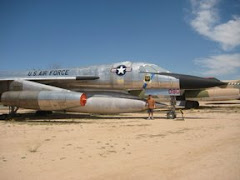
You never know where you’re going to find aviation history.  Sometimes it is sitting out for all the world to see, but no one sees it because it is just so obvious.  Take this for instance.  This is out in the hills south of Satus, Washington.  I happened to be out for a drive and had decided to turn around and go back.  I glanced at this twice.  At one point my glance wandered across the “J57” and it occurred to me that there was a jet engine called that.  When I looked back, I saw this!  Well, obviously, I had to stop and take photos.
DSC_0079
The J-57 was a turbojet engine that powered many of the USAF’s 1950s jets, and some of the Navy’s.  They were manufactured from 1951 to 1965, with over 21,000 built!  The B-52 was originally powered by the J-57, as were the F-100, the F-102, the Navy’s F-8 and F4D.  It was a widely used engine.  And this is evidence of it’s existence.
DSC_0080
These “cans” are what they used to transport the engines in.  They were obviously water-proof, especially, since this is being used for water storage. 
DSC_0082
So, keep your eyes open, things like this are out there in the open.  You just need to recognize them!
DSC_0083
Have you seen something in Washington State that just screams aviation history to you?  Drop me a line about where it is, and if you send me a photo, I’ll post it here!

Sunday, November 15, 2009

Fifty Caliber

Developed during the closing days of WWI, the fifty caliber did not enter service until 1921. The Browning Mk. 2 heavy machine gun uses this round. Originally in water-cooled variants, the Mk. 2 was also used in air-cooled versions later. In fact the Mk. 2 is still in service today. By WWII, it was used by land, sea, and air units.

The specimen seen here was found on the Zillah Gunnery Range, in Central Washington, by my uncle. The Zillah range is an area which was used by the US Navy for ground attack training. I have very little information on this area. There are conflicting opinions from locals that the area was either very small or stretched almost to the Hanford Reservation.
Note that the round appears to have received a tremendous blow to the casing. Note also that there appears to be no crushing damage, so, it seems unlikely the dent was caused by being driven over by a land vehicle. My admittedly hazy understanding of aerial machine guns would interpret this shell is proof of a great fall after an aircraft charged or cleared its guns. I know that there were solenoids that that allowed remote firing of these guns, and suspect it was possible for them to clear jams remotely, too. If someone out there can confirm or deny this possibility, I would appreciate it if you would leave a comment doing so, possibly explaining the processes or capabilities of such weapons as related to clearing a live shell from the chamber.
I did receive a response from the USN concerning the collision of two F6F Hellcats over the Zillah Range on August 14, 1945. It took four months for them to get round to sending a single page. I am now getting ready to write to the National Archives for more information. I noted in a letter to the USN that the USAF saw fit to write up to 30 pages on an accident report, while the single Army accident report I have is over 200 pages in length, surely the USN did more than note the time, date, and tentative cause of the accident. Alas, we see the differences in the branches of the US Military.