
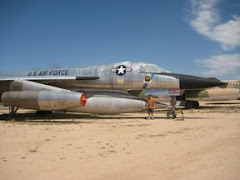
This is 67-0013, she resides at Pima Air and Space Museum. She retired with 38,225 flight hours. Photo taken Spring of 2008.
During my childhood, in the 1980s, to see a Lockheed C-141 Starlifter, all you had to do was wait until about 5:15PM, then look up. Our house was directly under their training path. A-6 Intruders also used the same path at times, too. The C-141s originated from McChord AFB, near Tacoma, Washington. McChord remains a transport hub for the Air Force to this day. Today, however, they fly the C-17 Globemaster III. The C-17 is comparatively new, though. The Starlifter flew from the mid-1960s until May of 2006.
In the early days of any aircraft’s service, accidents happen more often than in its later life. For example, the F-106 served from the late 1950s to 1988. The majority of accidents both flight and otherwise, happened in the early 1960s. The same was not true for the C-141. The accidents for the C-141 continued throughout its lifetime. A cursory exam of the losses indicates no particular time where there were more. In fact, 281 was the first C-141 lost to any cause, an entire year after Dover AFB received their first C-141.
I usually write up accidents that happened in flight, usually because one has at least a small chance of locating it and seeing it. This accident, however, was an accident that happened while it was parked on the ramp. The entire aircraft was destroyed. Why write on this? The C-141 had a VERY long history in Washington State. It holds a special place in my heart because of my childhood memories. And there are only two accidents that destroyed a C-141 in Washington State of which I am aware. It was the first C-141 lost. And three men, Michael Solomon, Ralph Gentry, Jr., and James Norman, lost their lives because of it.
On August 29, 1966, C-141A #65-281 was delivered to the USAF. It had about 12 flying hours on it when it was delivered, and only about 53 flying hours at the time of the accident (for transports, that is an amazingly low number). By the end of their careers, the average flight time for retired C-141s was 37,000 flight hours. C-141 # 65-0251 had an amazing 46,732! The ship listed with the least number of hours, by the way, is the subject of today’s article.
On September 7, 1966, in the early morning hours, C-141 #65-281 was consumed by fire while parked on ramp spot J-11. Three men died.
On the evening of September 6th, 281 was being readied for a scheduled mission. These preparations continued through the night. She had been plagued with fuel system and fuel quantity indication system problems since before delivery. In fact, there had been twenty-three write-ups even before delivery! Since delivery, little over a week previous, pilots had made eleven write-ups concerning the fuel system. The eleventh one was one of the subjects of this nights labors.
Problems with the system had been occurring all night. Removal, cleaning and reinstallation of the fuel quantity probes had not fixed the problem. Even substitution of probes from another aircraft failed to fix the problem. Due to these problems the mission was changed and crews began defueling 281 from 135,000 pounds of fuel to 80,000 pounds. Both the extended range tanks were emptied, which was completed at about 0545.
A fuel capacitance check was to be made on the right side extended range tank. This tank needed to be completely emptied and required draining it from the bottom of the wing. This was done by sticking a “condensate drain tube” into the fuel tank condensate drain valve. The fuel emptied through the tube into a bucket, which was then emptied into a fuel bowser(another term for mobile fuel tank).
During this time additional discrepancies were discovered. The aircraft power “ON” light was inoperative in the test position, and the rotation beacon was not operating properly. The team chief and three apprentices went to the aircraft cockpit to initiate a partial power on maintenance preflight, while the electricians began working on the AC power “ON” discrepancy. The electricians began by removing an electrical panel, but found the socket had power, so they sat on a lower bunk to study the electrical diagram.
Meanwhile two instrument specialists were working to diagnose the fuel quantity system under the right wing. They attached the C-141 adapter cables to the tank receptacle on the aft wing spar in the area of the flap well. These attached to a fuel test adapter and a test unit. These units were on a maintenance stand, and needed to be plugged into a power unit. A third instrument man proceeded to lay out a cord to the mobile power unit, which was fifty to 100 feet away, just around the nose of the aircraft.
At about 0629 power was interrupted, momentarily turning the lights out. The team chief looked out the window and saw a man at the mobile power unit instrument panel. He immediately switched the external power select switch to “off” and departed the aircraft to investigate the power problems. The electricians continued to examine the diagrams by flashlight. The chief was having words with the man at the mobile power unit when the instrument man plugged the power cord into the power unit. The chief turned and began to walk to the adjacent aircraft, which was also his responsibility.
It was at this moment, some 10 to 15 seconds after the cord was plugged into the power unit, that an explosion came out from under the right wing of 281. The explosion sparked a fire and men began to evacuate the aircraft.
All of the men made it out of the aircraft, departing by varied exits. One of the electricians, James Norman, however, chose to exit via the right rear troop door and suffered severe burns. He died nine days later. The two men under the right wing, Michael Solomon and Ralph Gentry, both received fatal injuries and burns. The entire aircraft was destroyed by the explosion and fire.

This is a photo of what remained of #65-281.Copyright: USAF Photo Via C-141 Heaven.


The C-141A was about 145 feet in length with a wingspan of 160 feet. Its wings were mounted high on the fuselage allowing the engines to hang from them, giving maintenance personnel better access than previous aircraft with reciprocating engines allowed. In the late 1970s and into the early 1980s, the entire fleet was modified to C-141Bs by adding a mid-air refueling capability and 23 feet to the fuselage, allowing more volume to be transported. It served for over forty years. They began service in 1965, and the last one was retired in 2006. If you would like to learn more about the men who flew and maintained the C-141 and the Aircraft itself, try going here.
Sources:
Accident report for #65-281, USAF.
C-141 Heaven, http://www.c141heaven.com/
Wikipedia.
Sources:
Accident report for #65-281, USAF.
C-141 Heaven, http://www.c141heaven.com/
Wikipedia.




 Posts


