Sunday, October 12, 2008

B-17F 42-5289, August 10, 1943


I got a comment a month or so ago concerning aircraft from Walla Walla Army Air Base. I took a look through my accident reports and located one in which the aircraft had originated from Walla Walla. I present, for your reading enjoyment, in a slightly more reader friendly format, the accident report of B-17F 42-5289 (condensed version).

B-17F 42-5289 was on a training mission out of Walla Walla AAB on the morning of Augst 10, 1943. It crashed at 0530 due to an engine fire. Seven crewmembers were lost, though three survived. The aircraft was a total loss.

(From S.Sgt. Marvin D. Anderson’s account)
Staff Sergeant Marvin D. Anderson, the engineer, was sitting on the floor of the top turret watching the instruments, when “All of a sudden the co-pilot, Lt Abel said, ‘No. three’s on fire.’” He got up and looked out to find the engine burning so hot that the cowling was melting and blowing off in the slipstream. He told the Pilot to feather it while he and the co-pilot attempted to put the fire out with the extinguisher carried by that ship. It did not work. He then feathered the prop and pushed the power to full on number two, which for some reason the pilot had reduced. The bombardier came up from the nose and asked what to do. Sgt. Anderson told him to salvo the bombs. At that point everyone began to put on their chutes. He then went through the bomb bay where he found that the bombardier had indeed dropped the bombs, but failed to open the bomb bay doors. Sgt. Block was jumping on the doors. Sgt. Anderson told him to get off the doors and then used the emergency release. The bombs fell away into the Columbia River. He called to the pilot to get out from over the river so they could jump. He waived Sgt. Block over the side and as he was watching the pilot come toward the bomb bay the fuselage melted away and the bomb bay was filled with smoke, flame, and molten metal. He jumped and floated to safety.

B-17 42-5383 was flying at 12,000 feet at 0528 and noticed a fire on the ground about two miles north of the range, across the river. When they let down to take a look, they saw three chutes and three men on the ground. They orbited giving details by radio to Boardman tower until a civilian car showed up. They landed back at Walla Walla at 0800.

The abstract of the accident says: The accident happened “12 MILES WEST OF PATTERSON COMMA OREGON AUGUST 10 COMMA 1943 AT APPROXIMATELY 0530 PERIOD NUMBER 3 ENGINE CAUGHT ON FIRE COMMA 7 FATALITIES PERIOD PLANE MANUFACTUREDJANUARY 4 COMMA 1943.” It goes on to say that the gear on that plane had been damaged in a previous accident, but the engines were new. Two things don’t add up. Patterson is in Washington State, on the North side of the river, while Boardman Range is in Oregon on the South side of the river. Elsewhere in the report it mentions that the crashed was only 2 miles West of Patterson.

The wings were torn from the aircraft and parts were strewn over a mile along the flight path. Examination of the wing indicated an internal explosion. This explosion would explain why the rest of the crew failed to exit the aircraft.

Crew list:

  • Pilot: Forrest F. Harvey, Fatal.
  • Co-pilot: Donald Abel, Fatal.
  • Navigator: Bernard Rote, Fatal.
  • Bombadier: Robert Drew, Fatal.
  • Engineer: Marion D. Andersonm, Survivor.
  • Engineer: William P. Bryant, Survivor.
  • Radio Operator: Ora W. Block, Survivor.
  • Radio Operator: Jerome J. Hatzewski, Fatal
  • Gunner: Edward R. Gesl, Fatal.
  • Army Air Force Gunner?(AAG): George W. Clark, Fatal.


The photos here are those that came from the report. They are obviously of poor quality due to the photocopying process used by the AFHRA. I also include one photo of a telegram so you can see some of the better copies, others are positively illegible. My appologies, Blogger posted it sideways.

If anyone is aware of the area of this crash, please let me know, I am curious and would appreciate any pictures you can spare of the area. I have not checked local papers.

Wednesday, October 8, 2008

Final Countdown


When I was young, my dad rented the movie The Final Countdown. It was a story of how the USS Nimitz (CVN-68) got sent back in time to December 7, 1941 via some sort of "time storm." It was a "what if." Of course, just as the strike group was about to lay waste to the Japanese strike force, the storm rose once more and the Nimitz strike group was recalled, Pearl Harbor be damned. History continued as though it had never had the USS Nimitz there in 1941. It was a neat movie for a kid.

I was always amazed at the ship's historian or whoever the hell he was. When he read off to the captured Japanese pilot the exact ships that participated in the attack on Pearl Harbor, I was in awe. If anything ever stuck with me, it was that scene. I hoped to be as prepared as that guy should I ever be taken back in time. (Ok, I get it, but I was young and dumb) I worked to learn more about history. Eventually, I could list the ships (American battlewagons, and Japanese Carriers present during the Pearl Harbor attack from memory...always with that stupid scene in mind. To this day, I am stuck with that scene in mind, convinced that I should be able to live out my life should I ever venture upon a time vortex unannounced...I would, of course, be shit out of luck if it landed me anywhere other than WWII or the Cold War...

Since we are on the subject of "what if," I was just reading little about the attack on Midway. The US would have been shit out of luck hd the Japanese been prepared to invade Midway on December 7, 1941. It would not have taken much manpower. I know the USS Nautilus was out there in that general neck of the woods, but it is obvious her captain was not in a position to throw back an invasion force. What if the invasion force had met the Pearl Harbor Strike Force as it was returning from Pearl? Then the Strike Force could have hit Midway and the invasion could have commenced with relatively few men. Instead, they waited six months and the US was ready for them...yes, there was considerable luck involved, but what if? What would US submarine forces done without the forward base for refueling before parol? What about the long range raids made by PB2Y Coronados on Wake? What other things would have been more difficult if not impossible without that base?

Please leave me your opinion on this what if. I appreciate a little imput, despite the subject's obvious lack of merit. I usually despise "What If" scenarios, but, curiousity has gotten the better of me...what if the Japanese had invaded Midway in December 1941? Would it have held out as long as Wake? I doubt it. I think Wake was better prepared. But, you tell me! I challenge you to play this game with me!

Sunday, September 21, 2008

Carriers


here is my Dad in PriFly on Hornet.


And the View from PriFly


This is the Hornet. I visited it a couple times while we were in California. I also managed to visit the Constellation in 1998(?), but I don't have any pictures...robably lost in the managerie of 35mm film bags that I have not developed yet...years of them.


Back in 1998 we were in Bremerton to visit the USS Missouri before her trip to Hawaii. Here is a picture of Lincoln during overhaul. You can make out a few Knox class FFGs, which re all gone now. Also, the hulls of several cruisers...robably Texas or California. I can't tell if Long Beach is visible or not...but she was there. You can also make out a couple submarine sails.


The Chinese bought the Russian carrier Varyag...apparently they are working it up. Here is a nifty little article on it.

Saturday, September 6, 2008

B-2 or not B-2, That is the Question!

I remember back in 1988, when the B-2 was unveiled. I thought it was a cool thing, since back then the Stealth was the newest thing. They kept having stealth fighters crash. In roughly the same period of time, they had unveiled both the fighter and the new bomber! Also, they were coming out with information on the ATF (Advanced Tactical Fighter), which would eventually have the YF-22 and YF-23 battle it out.


When they unveiled the B-2 there was loads of controversy. They were an awesome platform. These things had tons of prospects! They were prohibitively expensive, though. I still have a cartoon somewhere that has a Hamlet-esque character speaking to a skull in his hand and says, "B-2, or not B-2; that is the question!" The cost was 2 billion bucks a copy?!? Then the Cold War died. Up until that point it had a chance. As soon as the Cold War was over, so were prospects of armadas of radar invisible bombers. The Flying Wing, so long ago envisioned by Jack Northrop, was never to fly in great numbers. I found out recently about the crashof the B-2 on Guam. It had been deployed with two others. There were only 21 B-2s acquired. One rests in the Air Force Museum, and one was destroyed on Guam. That leaves 19 for training, maintenance, operations, and air shows. If you ever read memoirs of the Cold War, you know they had a third of their aircraft in maintenance, up keep, or IRAN (Inspect and Repair As Needed). Then a third of the squadron would be in training, and the final third would be deployed. That leaves roughly 6 B-2s ready for deployment at any one time.

I saw a show on the B-1 Bomber the other day. I did not realize it had been reengined for supersonic flight. Back when I was mildly interested in it, I knew it to be a toothless giant: Subsonic with a small bomb load. Well, apparently she is supersonic now, or my information was out of date. Also she carries a huge load of ordnance! They said that sometimes they will buzz enemy toops and they will disband and the bomber does not have to drop bombs.


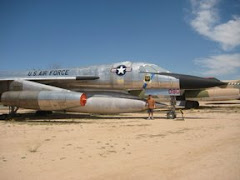
The F-22 Raptor was the winner of the YF-22 vs. YF-23 fight. I liked the YF-23 Black Widow better, but, over the past 15 years the F-22 has grown on me. It isn't SO ugly. My understanding was that the YF-23 was more stealthy than the YF-22, but because of the YF-22's vectored thrust, it was a better dogifghter than the YF-23. Something that I found interesting when we visited PIMA, was the front gate guardians. I had always assumed from pictures that they were F-22s...NOPE. They are YF-23s! Look! Must be someone there that liked the Northrop design better, huh? Well, me too!


Friday, September 5, 2008

RB-36H

I found a You Tube video of the RB-36H at Castle AFB. I have video, but it is several years old and I have not put it into a format that I can post. So, if you want a good look at this lovely behemoth, here it is. I wish I had taken more video and pictures...but it was before I had a digital camera.


I cannot describe the shear hugeness of this aircraft. I can give you measurements all day long. I can use big words and be a descriptive as possible and I wil still be unable to give you a feel for how big that aircraft is. The propellors are 19 feet in diameter. The tail is 46 feet tall. The fuselage is about 12 feet in diameter. Yes, the C-5B is gigantic and larger in comparison, but this bomber carried almost 20 people for a 48 hour mission. It also had a multi-megaton weapon in its bomb bay. This was America's big stick during the 1950s. It is trully an awesome sight. I highly recommend going to see it at the old Castle AFB in Merced, California. It is about two hours South of Sacramento and about an hour North of Fresno.

Thursday, September 4, 2008

I love the B-36


How can you not love an aircraft that is larger than most houses in square footage and interior space? Oh, and it can fly! Six turning and four burning! It could stay in the air for 48 hours! It could lift outrageous bomb laods! It had 8 dual 20mm turrets, plus tail guns!
This is from the movie Strategic Air Command. Something I need to add to my DVD library.

This is the B-36J from Fort Worth...she now resides at PIMA Air and Space Museum.

Tuesday, September 2, 2008

Stratojet Tube


I have been doing alot of reading about the B-47. The Bomber that the US built in greater numbers than any other after World War II. It had 6 J-47 engines. It was a very aerodynamic bomber and had difficulties slowing down. The wings flexed (up to 14 feet in flight).

If the aircraft was flying too fast and the pilot applied ailerons, the flexible wings could cause what was known as aileron reversal. This was because the flexible wing was acted upon by the aileron, but the speed was such that it twisted the wing causing the aircraft to flip in the opposite direction of aileron application.

Because of the great number of aircraft, there is a similar profusion of written personal accounts. I like this. I have a few books on this subject. One of my favorites is a collection of personal accounts called: Boeing B-47 Stratojet: True Stories of the Cold War in the Air, edited by Mark Natola. I have already related one of the stories in a previous blog.

Here is another quicky: A B-47 pilot and his crew were checking out a new B-47, when he saw a B-36. The Navigator was busy readying test the Bomb/Nav equipment. While they waited, the pilot let the B-36 go by, then followed. Due to the enormous bomber's slow speed and the B-47's relative sportiness, it did not take much to overtake the lumbering behemoth. The Pilot decided to play games. Finally, after messing around for several minutes with the B-36, he added "insult to injury, [he] dropped the forward gear and pulled away from him." Then he made a pursuit curve on the B-36, like a fighter would. It was then that the B-36 deployed his 8 turrets with 2 20mm cannon in each which began tracking him. He egressed the area in extreme haste. (I know, if you read my blog, I have found a joke with a similar setting and subject, and I have heard another version of this story somewhere along the line. Is it true or a Cold War Urban Myth?) The pilot and writer of this piece was Lt. Coonel Hank Cervantes, USAF, (ret.)

I found a You Tube of the B-47. In this clip you will see what appears to be views of a MITO (Minimum Interval Take Off), possibly during an ORI (Operational Readiness Inspection) at what I assume is McConnell AFB. I think some of it is from the Jimmy Stewart movie, Strategic Air Command. Note there are a few points in which the B-47 is completing a roll. That is evidence of the plane's agility. That also explains why it could perform the LABS maneuver. LABS stands for Low Altitude Bombing System, which sounds innocuous, but it included a low-altitude, high-speed run toward the target. The plane then quickly pulled up and began a loop. Near the vertical the bomb was released (tossed) and the plane followed through with the loop and finished headed in the opposite direction at maximum speed. The bomb could continue on for more than 20 miles. The clip shows you that this large aircraft was fairly adroit and nimble.

I recommend turning your volume down, since I did not choose the music.


Note: The Boeing factory resides here in good old Washington State. The XB-47 was tested at Moses Lake Army Airfield, later Larson AFB. There were jut over 2000 B-47s built in many different models. If you are inclined, I recommend learning a little more about them, comment and tell me you want a reading list and I will give you some titles to peruse. When you do read about the B-47, you will learn about the brave men who flew and maintained them.
OH, YEAH, this is the 63rd anniversary of the Official Surrender of the Japanese to Allied forces.