This excerpt, which I have borrowed from this site, (which is part of a history of his B-17 crew by Charles E "Chuck" Harris, it seems to be worth a read since it gives considerable insight into the training and eventual deployment of bomber crews) describes the usage of the Army Air Fields in the Great Basin. One can assume that Walla Walla AAF was home to B-24 training of similar scope. :
Phase training for all crewmembers included both ground and flight school. In general, ground school was conducted in the mornings and the crews then assembled for flying in the afternoon. It probably did not take long for the crews to appreciate that they were not flying with an experienced pilot. After graduating from cadet flying school, pilots received about two months of B-17 transitional training and were then assigned to phase training fields such as Ephrata. There is little doubt that the pilots proficiency was graded daily by the crewmembers. Bumpy or hard landings, less than smooth maneuvers in the air (particularly formation flying) was painfully obvious. The training at Ephrata did, however, enable the crews to get to know and evaluate each other and to start the slow process of integration into a smooth working team.
Flying at Ephrata became pretty much routine – some flights were navigational, a few included practice bomb runs but most were aimed at getting the crew to work together and to learn required procedures. All flights were limited to a specified area of Washington State. However, on one navigation mission in September, we "unintentionally" strayed and found ourselves looking down from a rather low altitude spectacular Grand Coulee Dam. That broke the routine! For me, it was of special interest since, since as an engineering student, I had visited the dam in 1939 when it was under construction.
I have spent this weekend surfing the web. Many things have come from this. I have discovered several sites of interest and have contacted a few gentlemen who have knowledge of wrecks here in Washington. I look forward to a few more accident reports from Maxwell AFB, since I requested a few this week...they should be here sometime during late December.
If you happen to be interested in wreckchasing, have information about one here in Washington State, or served in the military and might have something to add to this site, please, PLEASE leave a comment! I think opening this site up to other's ideas, thoughts, and information might be a good thing! Welcome all!
Sunday, November 30, 2008


Saturday, November 29, 2008
Visit a Museum

I don't visit enough museums. Then again, there are a bunch of things I don't do often enough. Museums, I feel, are repositories for memories and artifacts of everyday life. There are many museum types. There are museums for quilts, cameras, cars, prisons, farm equipment, airplanes, and, here in this post, ships.
This museum is in Bremerton, Washington. It is the Naval Museum of the Pacific! I visited it about...well, no, exactly a decade ago. This is an excellent place where nifty little items reside.
Want to know how a steam torpedo worked? Ever wondered what happened to Admiral Dewey's office chair? What about the ship's bell of the USS Washington? 


There is also a plexiglass model, some fourteen feet long or so, of the USS Midway(CV-41). (Or there was, it's been 10 years)
Visiting this museum was, perhaps, a turning point for me. I had not decided to become a teacher, yet, but it ignited more than a spark of interest in things old. I began reading more about historic battles. Especially Admiral Dewey's part in the Spanish American War. I also read a great book about the exploits of the USS Washington because of this visit.
It was the first time I had been close to a mine, a depth charge thrower, and any number of items on display. It made these things somehow more real. I need to go back and see the museum again. I also need to visit the submarine museum in Keyport. I was there once...about 10 mintes before closing time. Needless to say, I missed the most of it.
So, here is a thought. I want everyone to visit a museum in the near future. See what these volunteers, because most of them are volunteers, are trying to keep alive. See what you missed because you were born too late. See what you used to work with.
Should you get the chance, visit the Naval Museum of the Pacific, take a few pictures, let me know how your visit went! I will post it here. It isn't everyday you get to see Admiral Dewey's Office Chair...or his couch.
[Update: work on the Exercise Coulee Crest post continues, I am still looking for more contributors, photos, and any other items or info that may relate to the exercise. If you would like to contribute to this blog concerning anything you have seen here, please say so in a comment and leave your e-mail address, I promise to respond.]
Saturday, November 15, 2008
Century Series
I have not posted lately. I want to post a special post about Exercise Coulee Crest using the information I hve gotten from a very generous reader, but, I also want to post pictures of the area he refers to. I have not yet otained those photos. So, in order to keep this Blog in a semi-live state, I have here a few photos.
The Century Series was a series of fighters developed during the 1950s. Their designations were three digits, thus the term Century Series. Not all were fighters, but, whose going to nitpick that? Some might complain that I did not include the F-111 or the F-117, but, come on, those just are not in the same league.
First is the F-100. The first production aircraft capable of breaking the sound barrier in level flight.

The F-101 was an interceptor, hardly maneuverable enough to be a dogfighter.

The F-102, the first Delta Winged production aircraft in the US inventory.

The F-104, a VERY FAST plane. Fast.

The F-105, a tactical nuclear strike fighter...read bomber, still, they were responsible for shooting down seveal MiGs.


The Century Series was a series of fighters developed during the 1950s. Their designations were three digits, thus the term Century Series. Not all were fighters, but, whose going to nitpick that? Some might complain that I did not include the F-111 or the F-117, but, come on, those just are not in the same league.
First is the F-100. The first production aircraft capable of breaking the sound barrier in level flight.

The F-101 was an interceptor, hardly maneuverable enough to be a dogfighter.

The F-102, the first Delta Winged production aircraft in the US inventory.

The F-104, a VERY FAST plane. Fast.

The F-105, a tactical nuclear strike fighter...read bomber, still, they were responsible for shooting down seveal MiGs.

The F-106, the replacement for the F-102, continued service into the 1980s.

And, finally, the F-107, which was an up-engined F-100 derivative.

These are all my own pictures, which I took with my own camera. I am proud to have seen the entire series in one for or another.
Thursday, October 30, 2008
October, 1962
So, 46 years ago we had the Cuban Missile Crisis. It was 46 years ago today and Friday that the four Foxtrot subs were surfaced. They were armed with one nuclear torpedo each. I think we ought to look back at that period and think about how it could have been...someone's finger could have slipped so easily...
As a result of Kennedy's entrance into the White House, and the difference between his and his predecessor's approach to world political problems, the US military had widened its conventional abilities. By the time of the Cubn Missile Crisis, the US had significant conventional forces ready for deployment. There were several exercises in the first half of 1962 that worked toward smoother communicaions, operations, and planning between services. In the Spring of 1962, forces had completed an exercise in Washington state called Exercise Coulee Crest. Inthe coming weeks (preferably sooner) I plan on writing a bit more about Operation Coulee Crest. I have received more information from Mr. Loewenstern and am working it up.
As a result of Kennedy's entrance into the White House, and the difference between his and his predecessor's approach to world political problems, the US military had widened its conventional abilities. By the time of the Cubn Missile Crisis, the US had significant conventional forces ready for deployment. There were several exercises in the first half of 1962 that worked toward smoother communicaions, operations, and planning between services. In the Spring of 1962, forces had completed an exercise in Washington state called Exercise Coulee Crest. Inthe coming weeks (preferably sooner) I plan on writing a bit more about Operation Coulee Crest. I have received more information from Mr. Loewenstern and am working it up.
Thursday, October 23, 2008
Bell X-14
OK, I have to hand it to certain people. It is rare that anyone stumbles upon something of such historic value, let alone that someone knows what they are looking at when they do. Such is the case with this gentleman who is apparently travelling across country. I heartily recommend you stop at his blog and look at the pictures he took of the X-14...an early attempt at VTOL. There was only one built and it would have been gone if the Ropkey Armor Museum had not saved it a decde ago. So, go to both sites and have a look! It is good when valuable aviation history can be saved. Now, about those XB-35s...
Wednesday, October 22, 2008
Guardian

The AF-2 Guardian was an anti-submarine aircraft. There were two variants. One had a radar(hunter) and one carried the bombs/depth charges(killer). These were sub hunters. They only operated for a comparatively short time(5 years: 1950 to 1955). I would not have known bout their existance, but I managed to stumble across one at Aero Union in Chico, CA. This was obviously a fire fighting veteran, but not much remained. I took these photos in 2004. At the time there were several C-54 hulks and a few P-2Vs sitting out in their boneyard.

One supposes, if the stars aligned and there was a need or a want, this specimen could be restored. Obviously the museums of the world have taken on much sadder cases. Here is another link that has a bit more informtion on the Guardian. And this is Aero Union's website.

Below you see what it probably looked like as a fire bomber. This is the specimen at PIMA Air Museum in Tucson, AZ. It is amazing how large these aircraft are. The wingspan was 60 feet! It was 43 feet long. It gives the A-1 a run for its money, size wise. Though, anyone who has seen an A-1 up close knows they are truely MASSIVE. The Guardian only had an R-2800(Same as on the F-4U early variants), while the A-1 had an R-3350, similar to that on the B-29.

UPDATE for Coulee Crest: "I participated in Exercise Coulee Crest. This was a III Corps exercise. III Corps consisted of the 1st and 2nd Armord Divisions at Ft. Hood, 4th Infantry Division at Ft. Lewis and the 5th Mechanized Division at Ft. Carson Colorado. The 4th and 5th Divisions artiliary units were the participants as this was a live fire exercise at the Yakima Firing Range. There were Air Force and Navy units involved to see how well communication worked between services."~Mr. Loewenstern.
Thank you for the continued input! I wonder if you remember where abouts you were billeted, if anywhere for any particular length of time. I have some local folks who remember being able to see the camps on the south side of the Firing Center, from Moxee. One gentleman also remembered that the troops would clean the local store out of beer.
Army, Air Force, and Navy...hmmm, that WAS one LARGE exercise.
Wednesday, October 15, 2008
Coulee Crest Revisited
I had made a request to the AFHRA (AFHRA.NEWS@MAXWELL.AF.MIL)to send me information on Operation Coulee Crest several months ago. Turns out there was literally tons of informtion on Coulee Crest in AFHRA records. There were fees attached, and given my passing interet in the subject, I decided against requesting more information. I will see if I can post the long list of records that they COULD have sent me...$30 per roll. With this information, you can, should you see fit, ask the AFHRA to retrieve this information for you. OK, it was WAY TOO LONG. If you are interested in this list, I will e-mail it to you if you leave a comment requesting such. You may want to leave your e-mail, too. (I can erase your e-mail from the comment bar if you request) If you do order from AFHRA, here is a warning: Some of the copies you receive are not altogether clear. You may have to have a second sight to read some of the papers, still, they can hold useful info.
I got a great comment the other day. A gentleman from Texas, a Mr. Loewenstern, let me know he had participated in this operation. He had this to say: "Our unit was airlifted from Fort Hood Texas on 18 C124 and after landing at Sheapard Air Force Base for refuling we next landed at Larson Air Force Base on April 24th 1963." His comment confirms the presence of C-124s in the exercise. Given that the US had tken delivery of 448 C-124s when production ended in 1955, 18 of them in 1963, was likely a sizeable portion of the fleet. They could carry upwards of 200 troops. I am unsure of how large a unit Mr. Loewenstern was part of, but one can imagine that about half of them were used for troops, that is about 1800 men. I suppose it would be important to know what kind of unit he was in, also. Armored? Infantry? Artillery? I hope Mr. Loewenstern will see fit to disclose more information in the near future, if only for my own curiousity! Thank you sir!

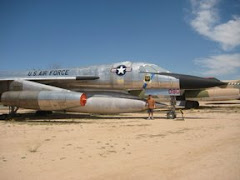
C-133s were also used in the transport of supplies and equipment. EB-66s were used in Electronic Warfare(See the photo of one here, taken at Larson AFB during that exercise) also. What else was used? I can only offer conjecture. I suspect A-1s, A-4s, C-130s, F-100s, RF-101s, F-105s, and maybe RB-47s. I don't know this, merely suspect.

I got a great comment the other day. A gentleman from Texas, a Mr. Loewenstern, let me know he had participated in this operation. He had this to say: "Our unit was airlifted from Fort Hood Texas on 18 C124 and after landing at Sheapard Air Force Base for refuling we next landed at Larson Air Force Base on April 24th 1963." His comment confirms the presence of C-124s in the exercise. Given that the US had tken delivery of 448 C-124s when production ended in 1955, 18 of them in 1963, was likely a sizeable portion of the fleet. They could carry upwards of 200 troops. I am unsure of how large a unit Mr. Loewenstern was part of, but one can imagine that about half of them were used for troops, that is about 1800 men. I suppose it would be important to know what kind of unit he was in, also. Armored? Infantry? Artillery? I hope Mr. Loewenstern will see fit to disclose more information in the near future, if only for my own curiousity! Thank you sir!

C-133s were also used in the transport of supplies and equipment. EB-66s were used in Electronic Warfare(See the photo of one here, taken at Larson AFB during that exercise) also. What else was used? I can only offer conjecture. I suspect A-1s, A-4s, C-130s, F-100s, RF-101s, F-105s, and maybe RB-47s. I don't know this, merely suspect.


Subscribe to:
Posts (Atom)




 Posts
Posts


