Saturday, February 6, 2010

C-141A 65-281 Burns on Ramp At McChord AFB.

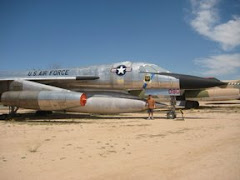
This is 67-0013, she resides at Pima Air and Space Museum.  She retired with 38,225 flight hours.  Photo taken Spring of 2008.

During my childhood, in the 1980s, to see a Lockheed C-141 Starlifter, all you had to do was wait until about 5:15PM, then look up.  Our house was directly under their training path.  A-6 Intruders also used the same path at times, too.  The C-141s originated from McChord AFB, near Tacoma, Washington.  McChord remains a transport hub for the Air Force to this day.  Today, however, they fly the C-17 Globemaster III.  The C-17 is comparatively new, though.  The Starlifter flew from the mid-1960s until May of 2006.

In the early days of any aircraft’s service, accidents happen more often than in its later life.  For example, the F-106 served from the late 1950s to 1988.  The majority of accidents both flight and otherwise, happened in the early 1960s.  The same was not true for the C-141.  The accidents for the C-141 continued throughout its lifetime.  A cursory exam of the losses indicates no particular time where there were more.  In fact, 281 was the first C-141 lost to any cause, an entire year after Dover AFB received their first C-141. 

I usually write up accidents that happened in flight, usually because one has at least a small chance of locating it and seeing it.  This accident, however, was an accident that happened while it was parked on the ramp.  The entire aircraft was destroyed.  Why write on this?  The C-141 had a VERY long history in Washington State.  It holds a special place in my heart because of my childhood memories.  And there are only two accidents that destroyed a C-141 in Washington State of which I am aware.  It was the first C-141 lost.  And three men, Michael Solomon, Ralph Gentry, Jr., and James Norman, lost their lives because of it.

On August 29, 1966, C-141A #65-281 was delivered to the USAF.  It had about 12 flying hours on it when it was delivered, and only about 53 flying hours at the time of the accident (for transports, that is an amazingly low number).     By the end of their careers, the average flight time for retired C-141s was 37,000 flight hours.  C-141 # 65-0251 had an amazing 46,732! The ship listed with the least number of hours, by the way, is the subject of today’s article.   

On September 7, 1966, in the early morning hours, C-141 #65-281 was consumed by fire while parked on ramp spot J-11.  Three men died. 

On the evening of September 6th, 281 was being readied for a scheduled mission.  These preparations continued through the night.   She had been plagued with fuel system and fuel quantity indication system problems since before delivery.  In fact, there had been twenty-three write-ups even before delivery!   Since delivery, little over a week previous, pilots had made eleven write-ups concerning the fuel system.  The eleventh one was one of the subjects of this nights labors. 

Problems with the system had been occurring all night.  Removal, cleaning and reinstallation of the fuel quantity probes had not fixed the problem.  Even substitution of probes from another aircraft failed to fix the problem.  Due to these problems the mission was changed and crews began defueling 281 from 135,000 pounds of fuel to 80,000 pounds.  Both the extended range tanks were emptied, which was completed at about 0545. 

 A fuel capacitance check was to be made on the right side extended range tank.  This tank needed to be completely emptied and required draining it from the bottom of the wing.   This was done by sticking a “condensate drain tube” into the fuel tank condensate drain valve.  The fuel emptied through the tube into a bucket, which was then emptied into a fuel bowser(another term for mobile fuel tank). 

During this time additional discrepancies were discovered.  The aircraft power “ON” light was inoperative in the test position, and the rotation beacon was not operating properly.   The team chief and three apprentices went to the aircraft cockpit to initiate a partial power on maintenance preflight, while the electricians began working on the AC power “ON” discrepancy.  The electricians began by removing an electrical panel, but found the socket had power, so they sat on a lower bunk to study the electrical diagram.

Meanwhile two instrument specialists were working to diagnose the fuel quantity system under the right wing.  They attached the C-141 adapter cables to the tank receptacle on the aft wing spar in the area of the flap well.  These attached to a fuel test adapter and a test unit.  These units were on a maintenance stand, and needed to be plugged into a power unit.  A third instrument man proceeded to lay out a cord to the mobile power unit, which was fifty to 100 feet away, just around the nose of the aircraft. 

At about 0629 power was interrupted, momentarily turning the lights out.  The team chief looked out the window and saw a man at the mobile power unit instrument panel.   He immediately switched the external power select switch to “off” and departed the aircraft to investigate the power problems.  The electricians continued to examine the diagrams by flashlight.  The chief was having words with the man at the mobile power unit when the instrument man plugged the power cord into the power unit.  The chief turned and began to walk to the adjacent aircraft, which was also his responsibility. 

It was at this moment, some 10 to 15 seconds after the cord was plugged into the power unit, that an explosion came out from under the right wing of 281.  The explosion sparked a fire and men began to evacuate the aircraft. 

All of the men made it out of the aircraft, departing by varied exits.  One of the electricians, James Norman, however, chose to exit via the right rear troop door and suffered severe burns.  He died nine days later.  The two men under the right wing, Michael Solomon and Ralph Gentry, both received fatal injuries and burns.  The entire aircraft was destroyed by the explosion and fire. 

This is a photo of what remained of #65-281.Copyright: USAF Photo Via C-141 Heaven.

Though the report does not give a cause, the real story is obvious.  Fuel had been drained in the vicinity of the electrical equipment being used to determine the cause of the fuel system problems, it seems more than likely that a spark from the equipment as it was warming up ignited fuel fumes in the area.  Fire is always bad for an aircraft.  

The C-141A was about 145 feet in length with a wingspan of 160 feet.  Its wings were mounted high on the fuselage allowing the engines to hang from them, giving maintenance personnel better access than previous aircraft with reciprocating engines allowed.  In the late 1970s and into the early 1980s, the entire fleet was modified to C-141Bs by adding a mid-air refueling capability and 23 feet to the fuselage, allowing more volume to be transported.  It served for over forty years.  They began service in 1965, and the last one was retired in 2006.  If you would like to learn more about the men who flew and maintained the C-141 and the Aircraft itself, try going here.


Sources:


Accident report for #65-281, USAF.


C-141 Heaven,  http://www.c141heaven.com/

Wikipedia.

Thursday, January 28, 2010

January 28, 1986

Twenty-four years ago, I sat in my sixth grade classroom. We were not in class very long before Mr. McKay wheeled in a TV and we began watching the truly memorable event on the news (This was long before our school had CNN). What we saw were the early moments of a NASA shuttle launch, something we had all grown used to. In fact my first grade teacher had made sure that we watched the first Shuttle take-off. I remembered the white fuel tank from that mission and did not understand the orange of the fuel tank on this one.

Then, as we watched, something around 28 pairs of eyes did not blink as the voices on the screen talked. Finally they said the words I will never forget: "Challenger, go with throttle up." at that moment, the orbiter, now many miles downrange, but still visible on the television screen, disappeared into a strange puffy cloud from which emerged, a half second later, the solid rocket boosters. They continued in oddly stable paths across the sky.

I will never forget that day. I don't remember how long we watched it, but I think we did eventually get on with lessons that day. I never liked Mr. McKay much, I thought he picked on me. I know better now. I am glad he wheeled that big old TV in and let us watch the event. It was something I doubt I will ever forget.


Then, seventeen years later, on a February morning almost to the day, the Space shuttle Columbia fell Earthward. I was living in Northern California at the time, and had I been awake, I may have seen the incoming orbiter as it raced through the atmosphere. Its path was not far from our area. At the time our alarm played the radio to wake us up. The voices brought us from our sleep with the words that everyone would remember this day. I don't know if my Columbia memory will ever have the same clarity that I have for Challenger, but I hope we all take a glance at the sky today to remember all those astronauts who have given their lives today.

Saturday, December 26, 2009

Movie- Lost Missile- 1958

An "Alien Missile" has found it's way to earth and the Soviets have diverted it across the North Pole. It has behind it a 1,000,000 degree heat blast. How do we stop it before it incinerates the world? This movie, while less than wonderful in plot, is a wonderful view into the world view of America circa 1957/8. It also shows what a Project Pluto type missile might do, albeit, with heat effects rather than radiation.

During the movie you get introduced to the DEW line (Distant Early Warning) and SAGE system. At one point the screen shows an F-89 which is intercepting the "missile." in the next ten seconds the screen shows the F-89, an F-86, an F-84, an F-94, and an F-100, all purporting to be the same aircraft.

This movie, while striving to be a Sci-Fi flick only manages to be a thinly disguised demonstration of how well the US was prepared for the unthinkable. While not great for action or drama, it does show video of the various types of aircraft and air defense hardware available at the time. They even show the Nike Missile System. It also explains, in words the civilian could understand, what each part did. You will see Hawker Hunters, Canadian CF-100s, B-52s, B-36s, B-47s, F-102s, and more.

You can also see the thorough (NOT) understanding of radioactivity that the writers had. The hero dies because he was within a few feet of some plutonium unprotected. It is something that can be chuckled at now, but it must have been scary then.

You can see it all on hulu right now. It is definitely worth a viewing for those of you interested in Cold War History. Enjoy!

Tuesday, December 22, 2009

LCS by General Dynamics!


It has been awhile since I last posted, but suffice it to say that the holidays have seen me more busy than usual. To break the silence, I would like to point you to the General Dynamics site. Yes, the same company that built the F-16 Fighting Falcon. They also deal in ships (Same way as Lockheed/Martin and Northrop/Grumman). I am sorry to say this has little to do with Washington State, but I hope you will indulge me...besides, we have littoral waters that this ship could defend!

Yes, that is a Trimaran configuration. It is meant for littoral combat and patrol. (That means close to the shore) A generous GD employee, doubtless seeking publicity for the company, sent me a link to some videos of this new ship underway. There are two classes. One with the lead ship of Freedom and the other with the lead ship of Independence. This is the Independence. Have a look and we will overlook the possibility that I may be helping "The Man" by acknowledging that this thing is damned cool. (this site remains advertising free, however, if you represent a government body interested in this weapons system and you buy one of these things, feel free to advise GD to send a few bucks my way- see, History guys CAN have a sense of humor )

Thank you Mr. Kello of General Dynamics!

Friday, December 11, 2009

F-106 #59-022, Raymond, Washington, October 3, 1967

(Photo of #59-022, from Marty Isham Collection via http://www.f-106deltadart.com [I shamelessly heisted it, but you should definitely stop by this site, since they are the penultimate experts on all things F-106!])
The F-106 was a wonderful craft. It could dog-fight. It could go supersonic and reach incredible altitudes. It was equipped with the amazing MA-1 fire control system, which, hooked into the SAGE network could guide it to a target and fire its weapons almost completely automatically. In its almost 40 years, it had the best safety record of all Air Force single engine aircraft, still, of the 340 aircraft built, 112 were lost in operational accidents, either on the ground or in the air.

In the late 1960s, the F-106 fleet had been selected to be modified with Supersonic external fuel tanks and in-flight refueling equipment. This was begun in 1967. The first of the sixes to obtain these modifications were Washington State based sixes. On October 3, 1967, F-106A, #59-022 was scheduled for a functional test flight after having these modifications.

Major Richard S. Petersen was assigned. He filed a DD form 175 (IFR flight plan, or Instrument Flight Rules[indicates he would be using instruments and electronic means to fly the aircraft, usually used in poor weather, rather than visual flight rules used in clear air]) at the Base Operations as LK 19 (Lima Kilo 19). The estimated departure time was 1700Z, or 1000 local, for an hour and 15 minute test hop. He began his weather briefing at about a quarter to 0845 (1545z). The weather at McChord was 1000 feet scattered, 4500 scattered, and 7000 broken, with 15 miles visibility. Forecast was 800 broken, 4000 broken, and 7000 overcast with visibilty at 7 miles with light rain. He got a weather waiver from the deputy commander for flight operations (This indicates that it probably wasn't a big deal to fly in weather, since the waiver was given). Clearance was filed at 1556Z (0856 PST), a little over an hour ahead of scheduled departure.

Petersen went to the Fighter Squadron, donned his flight gear and proceeded to the flight line. He did his walk around and began his preflight. After engine start, though, he told the crew chief that the attitude director indicator (ADI) would not erect properly. An instrument technician was sent to the aircraft. He replaced the ADI power supply. Satisfied with the aircraft, the pilot taxied out and began his check lists, now 46 minutes behind schedule (1046).

Lima Kilo 19 was cleared to flight level 360, or 36,000 feet. departure instructions were to turn right to a heading of 288 and maintain 4000 feet until he was 7 miles west. When he reached this point he was cleared by RAPCON to climb to his assigned altitude. He was handed of to Seattle Center and then to ADC Control (landferry) when he was appoximatel;y 20 nautical miles south of Neah Bay for flight monitoring. Landferry cleared LK 19 for his supersonic run on a heading of 150, parallel to the shore, but at 20 miles out.

Lima Kilo 19 requested a 75 mile extension to his supersonic leg. When asked, he reported that his speed was mach 1.3 at 40,000 feet. At 1116 local, Lima Kilo 19 reported that he could not obtain mach and requested a recovery vector. The vector given was 040. He was cleared to descend to FL310 when he requested it. Seattle Center assumed control at 1122 and cleared LK19 to descend to 5000 feet.

At 1122:11 Petersen acknowledged the descent and reported out of 31000. Seven seconds later he told Seattle Center that he, "Would like a minimum of turns on the letdown 'til I can go VFR. I've lost my flight instruments, ..uh..attitude indicator tape." (most F-106s were equipped with vertical tape instruments that were supposed to be easier to read than traditional circular types. Supposed;y they could give more information faster than the traditional type) Two minutes later Petersen advised Seattle Center that he had, "lost all flight instruments of...sh...in a descent at this time--and I'd sorta like to bail out of this thing." The time was 1124:55. This was the last transmission that Lima Kilo 19 made.

Radar plots indicated that he was making a right turn from an Easterly heading to a Westerly heading. The aircraft crashed in an open field in a very steep attitude, the accident report estimated it at 60 degrees nose down. The final heading, on impact was turning right at 061 degrees, putting it on a South West track at that time. Major Petersen did eject, but unsuccessfully. The Canopy, the seat, and his body was discovered about 1/3 of a mile to the Southwest on a hill about 300 feet about the aircraft. The aircraft hit near Raymond Washington.

The weather was mostly cloudy if one reads the forecast correctly. Given the fact that he was cleared for Instrument Flight Rules, and his wish to obtain Visual Flight Rules conditions, it seems likely that his instruments were either giving him faulty or no reading at all. In that sort of environment, there is no horizon to gage attitude by. The motion of the aircraft is enough to over-ride the human cochlea and it is easy to think you are going in the right direction when you are not. Major Petersen seemed completely aware of this and was quite ready to depart the aircraft when his instruments began to go south.

Early F-106 ejection seats were notorious for poor performance. The early seats had been replaced by the "B" seat and finally by the "Zero-Zero" seat. This meant that it could safely take its occupant away from the airframe at Zero Altitude and Zero Speed. By 1967 most of the kinks had been worked out and the "Zero-Zero" seat had been fitted to the entire fleet.

It would appear that bad luck had been a large factor in Major Petersen's demise. First, bad luck that his instruments failed TWICE. Then that he was unable to complete his entire mach run. And, when his instruments failed a second time, his aircraft was in "the soup" (or bad weather) and he could not visually determine the attitude of his aircraft to bring it in safely. Finally, when he DID eject, something (and this accident report fails to identify what) caused him to sustain injuries that killed him.

The Convair F-106 Delta Dart was the interceptor that kept American skies clear of Communist aggressors for almost 40 years. It served with distinction, but never fired a shot in anger. After it was retired the majority of the survivors suffered the semi-inglorious fate of being used as targets. Some defend this as the most noble end for a FIGHTER, they consider it a better fate than sitting on a pole. Others may be saddened that a jet that kept America safe for so long suffered such an indignity. Either way, the SIX was a fighter no matter which side you land on. There are enough that remain today on display that most people will be able to see one in person if they don't mind a short drive.


Sources:

Accident report for #59-022 obtained from USAF.


Monday, December 7, 2009