Tuesday, June 8, 2010

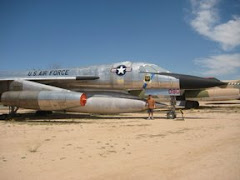
F-104A #56-840

I grew up in the Yakima Valley, in Central Washington State.  As a kid I recall sonic booms being a common phenomenon.  It was not out of the ordinary, as I grew up, to hear them.  I never paid much attention to them until our new next door neighbor moved in, in 1984.  He had just retired from the Air Force, where he worked on the SR-71 Blackbird.  He explained that the SR-71 had a characteristic double-boom.  We, as it turned out, lived UNDER one of their training routes.  We often heard the double-boom.  It was quite an experience KNOWING what was flying somewhere 70 miles down range, since the aircraft was no longer overhead when the boom reached us. 

I seem to recall a number of single booms, though, too.  This can possibly be confirmed with the fact that the USAF operated an intercept area to the south of us above the Horse Heaven Hills.  Super-sonic interceptors seem now to be a thing of the past, especially since the Soviet Union no longer seems a great threat with MANNED bombers.  Most of the air bases that interceptors operated out of are now civil airports.  Paine Field had an interceptor squadron, as did Geiger Field, and Larson AFB.  These are now civil airports.
 
Of course, the most common super-sonic interceptor that operated in Washington State would have to be the F-106 Delta Dart.  Over the years, though, F-82s, F-86s, F-94s, and F-102s all protected Washington State’s vital war making industries.  One interceptor, though, was exceptional in its capabilities, and despite this, it was not operated by the USAF in significant numbers.  It is, of course, the F-104A Starfighter.  (One of my favorites)

The F-104A was the sports car.  It was the thoroughbred.  It was made for speed.  It was small.  It could blister along and hold a speed of over Mach 2!  With a 21 foot wing span, it was tiny.  It performed!  It could reach bomber altitudes in 6 minutes.  It’s listed as having a maximum operational altitude of over 55,000 feet!  F-104s broke speed and altitude records, being the first aircraft to hold both the speed record and the altitude records at the same time.  F-104As reach over 90,000 feet!  The C model, with the -19 version of the J-79 engine broke even those records and reached 103,000 feet!  It was not uncommon for the early F-104 pilots to wear pressure suits. 

It was Wednesday, April 13, 1960.  Senator John F. Kennedy had announced his candidacy for the office of president a few months earlier.  France had detonated their first atomic bomb a few months earlier.   The winter Olympics had been held in Squaw Valley, California in February.  Ben Hur had won a record number of Oscars the week before.  Today, though, it was business as usual at Larson AFB.   A pilot was scheduled for a high altitude mission in an F-104A.

First Lieutenant William Thomas Tilson, of Limestone, TN, a USAF pilot with 521 total flight hours, was to perform a high altitude intercept mission in his new steed.  He had flown a total of 108 hours in F-104s.  88 hours in this model alone.  The other 30 hours were likely in the trainer version.  He had become a pilot on September 3, 1958.  His wife and 2 ½ year old daughter lived on base with him.[1]

This particular mission required the use of a pressure suit.  The planned altitude was to be 45,000 feet.  The Operations Officer briefed Tilson and his wingman on the coming mission.  His wingman was Lt. Robert G. Moore.  Moore would not be wearing a pressure suit.  Tilson was assigned aircraft #56-840.  He and the squadron pressure suit specialists preflighted the aircraft.  They then went to the pressure suit fitting room, where they dressed Tilson and checked his suit.  They all then went to the aircraft and strapped Tilson in.  The suit was again checked using the aircraft oxygen test switch. 

The flight was delayed for 20 minutes when the target aircraft aborted after take-off.  This aircraft could have been a B-52 from Fairchild.  Then flight was delayed another 20 minutes waiting for an instrument clearance.  When he finally received clearance, he taxied to the active.  He made the requisite calls to the mobile control unit.  (Mobile control usually had an active pilot who evaluated take-offs and landings.  It was usually a small green house-like structure that was situated on a part of the field away from the main control tower.)

The flight lifted off at 1035 AM.[2]  All was normal, but at 25,000, Tilson allowed his speed to drop below .7 mach.  Normal climb was made at .85 mach.  They broke out of the clouds at 32,000 feet, at which time Tilson resumed normal climb speed.

Tilson and wingman contacted the ground control site.  Tilson was vectored Northwesterly, while Moore was vectored to the West.  Moore would be playing the part of the target that had aborted earlier.  Both pilots put distance between each other for the intercept.  Then Ground control vectored them inbound.  Tilson was vectored behind Moore.  He was doing about Mach 1.4 and his altitude was 45,000 feet.  Tilson was conscious and answering instructions until he was three miles behind the target.  He still had not acquired the target.  According to ground control, he slowed.  He was instructed to break off the intercept and turn off his identification signal. 

Tilson did not acknowledge this transmission, even though it was repeated several times.  Then his identification signal faded and no other contact could be made with him or his aircraft.  The aircraft crashed not far from the area of the intercept, about half way between Farmer, Washington and Douglas, Washington, on Lawrence Egger’s farm. 

Tilson did not survive.  There is no more to my version of the accident report.  No indication as to cause, no indication as to why.  Nothing.  One hopes First Lt. Tilson’s widow and child took solace in the fact that he died doing what he doubtlessly loved doing. 

As usual, if you have any more information on this accident, please feel free to e-mail me and help me fill out the rest of the story.


[1] “Base Probes Fatal Crash” Spokane Daily Chronicle, April 14, 1960. http://news.google.com/newspapers?id=JJcSAAAAIBAJ&sjid=IfcDAAAAIBAJ&dq=william%20tilson&pg=4133%2C3873721

[2] The report says 1035P, but another part lists accident time as 1100 PST.  The F-104 was a day fighter, a night intercept does not make sense.

Sources:  
Author's personal recollections.

Accident report for #56-840, USAF

Spokane Daily Chronicle, April 14, 1960.

Friday, June 4, 2010

MIDWAY

Yes, it is the anniversary of the Battle of Midway.  This media animation/narrative on the US Navy site is an interesting way to review the events.  You might not want to take it at face value, however, for it failed to mention the role of radio intercepts and code-breaking.  Also, the IJN carrier Kaga is labeled KAGO on the map.  Other than that, it is still a fun ten minute or so narrative.

http://www.navy.mil/midway/MidwayMap.html

Saturday, May 29, 2010

X-51A hits Mach Six!

The X-51A, an unmanned test aircraft using scramjet technology hit Mach 6 (six times the speed of sound) and stayed there for 200 seconds on May 26, 2010!  That is a far cry from what the X-15 managed forty years ago!  The X-51 stayed above Mach 6 for an astonishing 200 seconds...Which means it traveled over 220 miles in that time!

The experiment was carried out from a B-52 bomber rigged for the job.  It was fired out over the Pacific.  The flight was terminated when the vehicle began decelerating.

for more information, you can go here, here, and here.

This isn't about Washington, but it's darned interesting, so I am sure you won't mind.

That's an Air Force picture, borrowed from cnet.

Sunday, April 25, 2010

The Tale of P-38 #44-23914

A fellow wreck chasing enthusiast and I visited the site of #44-23914 just over a year ago.  I was amazed at how  much, and yet, how little, remained.  The forces that are at play in an aircraft crash are phenomenal!  The majority of the pieces we saw bespoke a horrible and violent end.  There were pieces of aluminum that had been fold like an accordion.  Others were simply misshapen to the extent that their original form was unrecognizable.

My friend, Mr. Gould, obtained the accident report for #44-23914 and furnished me with a copy.  I now present the small amount of information contained therein along with some other components that will fill out the story.  Unfortunately, the report leaves more questions than it answers.

The day was September 30, 1944.  A few days earlier and about 20 miles to the south, the super-secret Uranium pile of the B-Reactor, part of the Manhattan Project, had gone critical for the first time.  Further away, men of the US and its allies in Europe had just taken part in in the ill-fated Operation Market Garden and were withdrawing to lick their wounds.  The situation in the Pacific was looking up, soon our forces would be gathering for another invasion, this time on the Philippine Islands.  The small town of Othello a few miles away was quiet, except for the freight trains bearing war materials every now and then. The wind was moving at a leisurely 9 miles per hour.  There were a few clouds above the valley floor.  The farm land did not show the scars of war, yet.  That would change this afternoon.

There were several Army Air Fields near by.  Moses Lake Army Air Field was the closest.  The fighters from that base would be training throughout the day over the farmland of Eastern Washington.  The fast Lockheed fighter was the one that was seen most.  It could be seen in flights of four, most days.  The pilots would be going through the various training missions.  From navigation, to bombing, to dogfights and low level flight.

The P-38 Lightning was recognizable because of its unique shape.  Instead of the normal cross shape of most aircraft, the P-38 looked a lot like two T's written close together and attached at the bottom.  It had two engines and was a great fighter as long as the pilot did not mistreat it.  A training film of the era cautioned against inverted flight for any length of time, as the oil pressure would drop dramatically and ruin the bearings in the engines.  It also stated that if you needed to recover the aircraft in a downward maneuver, you needed to have at least 10,000 feet altitude.

On this particular day, at 12:55PM, yet another flight of P-38s had left Moses Lake Army Air Field.  These four proceeded to a local gunnery range for a sighter burst and then climbed to 12,000ft. for a syllabus of "supervised acrobatics" and individual combat. (the number three man, 2nd Lt. James B. Keller, and number four man,2nd Lt. John W, Eveland, both stated that they were actually at 7000-8000, this difference in stated altitudes is interesting.  The leader, 1st Lt. Charles N. Fagan, stated that the cloud bases were at 7000-8000 feet and the cloud tops at 11,000.  Could this be a mix up?)

The leader strung his formation out in "String Formation." and began to "rat race" around the cloud tops.  This would appear to be simply a game of follow the leader.  At one point, about 1:30PM, according to all flight members, the formation passed into the top of a cloud or through a wisp cloud (again, they differ).  The flight members all stated that they were only in the cloud for one to two seconds at most.  They did not even switch to instruments.  When they entered the cloud, the number two man was there where he belonged.  When they came out he was gone.

The number two man was Flying Officer Gene L. Dyer, apparently of Australia.  He was flying P-38L #44-23914.  There were no problems listed concerning the aircraft, save for the left oil shutter which was left in automatic.  Dyer simply disappeared from the flight.  A BT-13 pilot, 2nd Lt. Morris D. English, flying in the general area witnessed a P-38 in a spin at about 1:20PM, it came out of the bottom of a cloud at about 6500 feet and at about 5000 momentarily recovered in a nose down position.  The BT-13 pilot did not see more because a cloud obscured his vision.

When he was noted as missing, his flight made radio calls to him and to Moses Lake tower.  They flew around looking for the crash site.  Then they headed back to the field to see what the tower knew.  Lt. Fagan took another plane out and searched for Dyer.  He located the wreck and guided the crash truck and ambulance to the site.

The majority of the aircraft was recovered.  What remains today are just small pieces.  Some of the cylinder housings from the engines, various hydraulic fittings and hoses, and even the side of a Browning Mk. 2 .50 caliber machine gun.  There is just a crater or impact scar that marks the place where Gene L. Dyer died.  There is no other marker.

What happened?  Is it possible for things to go so completely wrong in 1-2 seconds that you cannot even call for help in your plummet to the ground?  Given the characteristics of the P-38, and the eye-witness report from the BT-13 pilot, it seems that Dyer somehow got himself into a spin and may have been recovering.  The ground level at the crash site is about 1000 feet above sea level.  If the flight was at 12,000 feet, it seems completely possible that Dyer had plenty of room to recover.  However, if the two other members of the flight were indeed correct when they stated that the flight was at 7000 to 8000 feet, it seems Dyer was just too low to recover completely from the spin.

Is it possible that the three members of his flight were covering for each other when perhaps they had been doing maneuvers that were not permitted?  I do not know.  I only bring it up because of the amazingly short amount of time that he was out of sight and the conflicting reports, which do not seem to have been questioned by anyone.  Even though I am aware that accidents can happen very fast, the report just seems to be missing something.  I suppose we will never know for sure.


Sources:

USAF accident report for #44-23914

Personal observations of wreck site, March 14, 2009.

http://www.othellowashington.us/

YouTube, WWII era training film.
  http://www.youtube.com/watch?v=pDmIB7u18_0

Thursday, April 22, 2010

Hanford Tour Description

 Hanford, as a few of you may know was a little town of people that the US Government told to move so they could create the Hanford Engineering Works.  The US Government even moved the dead.  The graves were dug up and they were moved to the Prosser Cemetery.  This was part of the Manhattan Project of WWII, to produce Plutonium for the atomic bomb.

My wife and I went on a tour of Hanford yesterday.  It began with me signing up for the tour on March 9, at a few minutes after midnight.  We showed up at the “Manhattan Project B-Reactor” tour site yesterday at about 9AM, just off of Highway 240.  We showed our IDs and boarded the bus.

We drove past the 300 Area, where Uranium was made into fuel elements that would fit into the reactors.  300 Area was also where many of the laboratories were to do research on how best to do things.  Many of the offices for management are also in this area.  This is the area closest to Richland, Washington and can be seen without getting a badge or clearance.  

Then we continued on.  We passed what was once call WPPSS, or “WOOPS,” a series of three nuclear reactors, only one of which is running.  One is at 65% completion, and I believe the other is somewhere around 25% completed.  These three, viewed from above give you an idea of what a reactor looks like at different stages of construction.  The one that is running supplies a huge amount of electricity to the Bonneville power grid. 

We passed the LIGO facility, which monitors gravitational waves via a laser shot down “L” shaped arms that are almost 2 ½ miles long.   And we passed FFTF, the Fast Flux Test Facility, a reactor that had been run to test components for breeder reactors (reactors that create more atomic fuel than they use), and to test safety practices and other things related to both the civil fields of electricity production and medical radioisotopes.   

We got to the Wye Barricade (entrance) and waited while the bottom of the bus was sniffed by a K-9 unit.  We then proceeded north.  We drove past the old Hanford townsite, noting various features along the way.  The Hanford townsite was the site of the tens of thousands of workers who built the wonders of the Hanford Engineering Works.  It was a tent city that lasted less than two years.  You can read more here

We were then driven past the F-Reactor.  F-Reactor  was one of the three War-Time reactors that contributed Plutonium to the War Effort.  It is now cocooned.  It is a sad end to a brilliant piece of engineering. 

(Let me just add here, my opinion on the way they are handling things out there.  They are striving to return the land to a state where nothing remains of the Historic Presence of the US Atomic Energy Commission or any other entity that occupied or run part of the Hanford Reservation.  I disagree strongly with this.  These buildings should remain a part of our heritage!  Once they have been decontaminated, I believe they should remain for the generations that follow.  I believe there is no way to totally know an era unless you stand in their structures or within the areas they stood in.  I know that we can study the historical record, but honestly, you have to get your nose out of books sometime and look with your own eyes and see.  REALLY SEE, what they saw.  An example of that is standing in front of the B-Reactor face.  There is no amount of description that can give you the feeling that standing in front of the reactor can give you.  Nothing can give you an idea of the size of the Processing Canyons that being near them can do.  Nothing says COLD WAR like the construction techniques used here.  If we lose that we lose a chance for historians and people interested in history to experience it in person. )

Next we passed H-Reactor (also cocooned).   Then D-Reactor and DR-Reactor.  DR stands for D-Replacement.  These have all been cocooned.  Their size is remarkable, considering the lack of scale available in the desert.  See the photo below, which I have borrowed from the "Hanford Site." (forgive the pun)

Then we came to the N Reactor.  A dual purpose reactor.  It could produce electricity AND plutonium.  It was such a spiffy new design, President Kennedy stopped by to be part of the opening ceremonies!  An Aunt of mine was present at this occasion!  About six weeks later, that president was dead.  The N-Reactor, however, continued on unto the mid-1980s, when, sometime after the Chernobyl Accident in 1986, the US decided to shut the N-Reactor down for awhile because it shared some of its design with the Chernobyl Reactor.  They never did start it up again.  Three years ago, it was in decent condition.  Today they are in the midst of tearing it down and cocooning it.  Dammit.  

We passed the K East and West Reactors.  both cocooned.  Their basins have been the subject of some local media focus, since some unprocessed fuel rods were sitting underwater for many years and made clean-up a difficult job. 

Finally, we got to the B-reactor!  It is awesome!  That stack that rises above it?  That is a ventilation stack.  It takes the filtered air OUT of the reactor building, which was kept in a negative pressure environment.  We had an hour and fifteen minutes to spend, but it went WAY too fast!  We saw the air fans and the water coolant valves.  Up to 70,000 gallons of water per MINUTE was passed through the reactor!  It was designed to be a 250 megawatt reactor, but the guide said that toward the end they had it up to 2100 megawatts!  I wanted to know what it felt like at the face and he started to show me up to the face when our bus-guide said it was time to go...dammit!  

We stood in the control room, where Enrique Fermi stood 67 years ago!  We did not get to see the back of the reactor like I did three years ago, but that was a small price.  We could see some of the 29 holes where the SAFETY RODs were housed.  These would drop out of the ceiling and into vertical holes shutting down the reaction by absorbing neutrons.  This was my third trip out to the Hanford Area.  My second trip to the B-Reactor.  I plan on going back again.

After we left the B-Reactor, we drove to the 200 West Area.  This is one of the two processing areas.  The spent fuel rods would be placed into the "Canyons" and then subjected to chemicals that would break down the rods one element at a time, until, finally, a slurry of plutonium nitrate was left.  It was then further purified until it became a Plutonium hockey puck.  This was then it was shipped off to Los Alamos to be made into a bomb.  The guides were very PC and wanted to make sure we knew that Hanford was being cleaned up.  To show this we were shown ERDF, a giant pit where they bury dirt.  OK, it’s more than that, but, if you get down to it, that is what they are doing: Burying contaminated dirt.  You can read more about ERDF here, but we stood through the speech, and I am fairly certain they repeated themselves three or four times.  I’m not sure, I sort of tuned out. 

We saw the T-Plant, U-Plant and the Redox.  (That is REDOX above, with the smoke stacks of the coal plant behind, taken three years ago.) All three different buildings used to process fuel rods.  The Tank farms are located downhill from the processing canyons. 

We then went to the 200 East Area and saw the submarine sections, the parts of the hull that had housed the reactors of over 100 hundred submarines and surface ships.  We saw the vitrification plant from a distance.  (vitrification is the making into glass the solid wastes that are now in the tanks)   We also saw PUREX, the Plutonium Uranium Extraction building.  It is huge! See above, another picture borrowed from the Hanford website.

All in all, it was great to see the magnitude of the Manhattan Project.  It was awesome to see the size of the reactors and buildings, but it was sad to see so many reduced to nothing.  And worst of all, was the focus on how they are working to protect the environment.  I must state, I am all for protecting the environment, but I was REALLY interested in the HISTORIC importance of the area AND scientific problems that had been encountered and overcome!  Three years ago there were many more anecdotes shared by the tour guide, today, we got the PC version of everything and I was left wanting!  We made it back to our starting point about 5 hours after we left.

Interested in more?  Have a look here, it is on the B-reactor.  Or read Richard Rhodes’ book “The Making of the Atomic Bomb.” 

Monday, April 19, 2010

F-104C #57-912, May 10, 1963, Up Dated!

After some effort and several phone calls and a few e-mails, I may be getting a chance to visit the crash site of #57-912!  I will post more details as I get them.

UPDATE (5-10-10):  I hope to visit the Firing Center this weekend and see not only the crash site of F-104C #57-912, but also RA-24B #42-54295.  Unfortunately, it seems 912 is in the main impact zone...I will only be able to view it from about 1800 meters.  On the bright side, 54295 is within a short hike of the road!

Sunday, April 11, 2010

Nuclear Education

During the Cold War, Nuclear weapons proliferated.  Now, our government is still striving to reduce the number of Nuclear Weapons.  That is not within the aspect of this site.  However, given our CLOSE ties to Hanford, Washington, the following Youtube video IS.

Note that the Mark 3 weapon was the "Fatman" bomb, used in Japan.

This neat little Youtube video gives an instructional look at our Nuclear Weapons of that era.  It is a montage of a couple training films from that era, with a look at all of the ways to employ nuclear weapons.  It will keep you busy for 17 minutes, so be warned.  Still, if you are interested in such things, you will find it educational!

Note, especially, the referral to Nike Missile sites at about 15 1/2 minutes in.  I have been to a decommissioned Nike site.  There isn't much to see.  It's impressive to see them in their former glory!

So, here, have a look and a listen, maybe you'll learn something, or maybe you will see how close we came to a totally different world.  Either way, it is a good idea to see how it was.