Yesterday, that is. Yesterday, May 19, 2009, saw the Navy's newest carrier, the George H.W. Bush land its first fixed wing aircraft aboard!! I could quote the news story, but you should really have a look at the real thing here.
Lindbergh crossed the Atlantic 82 years ago today, landing in France at sometime after 10PM on May 21, 1927. Hows that for history?
OTHER NEWS: I recently found a place that I can get archival newspaper articles for free. I found that an Ohio paper ran a short story on the crash of the F-106 pilot, Tesmer, whose parents lived in Ohio. Free is good.
The Emory S. Land was in the news, too. Sailors aboard visited local schools. The Emory S. Land is a subtender assigned to Bremerton Naval Ship Yard. I have a picture I took of her here.
I got some more news on the L-20 Beaver/-21 crash near Lake Chelan. The author is working on the story and is willing to let me publish it here.
My latest batch of requests is near being processed by the AFHRA!
All in All, good news! Sorry it wasn't a more interesting post!
Wednesday, May 20, 2009


Sunday, May 10, 2009
F-104C #57-912, May 10, 1963

(the F-104D at McClellan Aviation Museum, now Aerospace Museum of California)
On May 10, 1963, (46 years ago today) Captain Victor J. O'Bryan strapped on an F-104C Starfighter for a Napalm and Strafe mission at the Yakima Firing Center. O'Bryan was part of a vast aerial armada that had been moved to the central part of Washington State for Exercise Coulee Crest. This exercise was designed to test the smooth cooperation of the different service branches. Captain O'Bryan was part of the 479th Tacticl Fighter Wing, and the 435th Tactical Fighter Squadron from George AFB. His aircraft would not last the day.
The mission was to rendezvous with an F-100F over the range in Central Washington and have the flight photographed on it's firing passes which would be coordinated by a Forward Air Controller (FAC). Weather was 4000 scattered, high thin scattered, visibilty was 15 miles and the temperature was 60 F. The wind was five miles an hour. The flight consisted of 4 F-104C Starfighters, made by Lockheed for the Tactical Air Command. O'Bryan was the number three man.

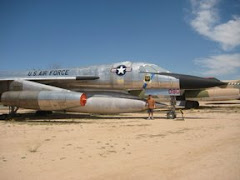
Why a thoroughbred fighter plane like the F-104 should be forced to carry bombs and troll around in the mud is beyond me. The F-104 did one thing very well. It went very fast. It was tiny. The cockpit is not far above the ground, in a pinch you could probably get into the cockpit without the benefit of a ladder. It was about 54 feet long with a miniscule wingspan of only 21 feet. Those wings had sharp edges and had special covers so ground crews would not injur themselves while walking around the plane (See photo below). It was difficult to find in the sky and it was very fast. It had one very powerful engine, the J-79, also used on the F-4 Phantom. The C model of the F-104 had a new model of the J-79, its diameter was three inches bigger, giving it about 1000 more pounds of thrust. However, "The F-104C had a number of operational problems with various components. The major offender was the J79-GE-7 engine--forty serious mishaps occurred over a five-year period, destroying 24 aircraft and killing 9 pilots. This led to Project Seven Up, a General Electric modification program for the engine which began in May of 1963 and ended in June of 1964. "* Still, the F-104 could deliver its small payload with devestating accuracy according to most sources.

The flight's call sign was Ritzy. The preflight had stressed safety procedures concerning the armament. The report states that the armorer noted nothing out of the ordinairy during the arming of the gun. Even another pilot from the flight had checked his gun door and felt that it was secure.
The flight took off at 1005 PDT and proceeded to the target area where they contacted Friend X-ray, their FAC. The F-100, call sign Boil 64, joined the formation on the wing of number four at this time. The FAC directed the flight to the target, 55 gallon drums and cardboard troop cut outs. The flight dropped its napalm on the first pass. They then went around for a gunnery pass. O'Bryan did not fire on the first pass because of the smoke from the napalm. At this time, Boil 64 lost his position on the number four aircraft and formed up on O'Bryan's wing for his second strafing pass. At about 2500 feet from the target, O'Bryan opened fire. He had only fired about 100 rounds when he felt a jolt in the aircraft and heard a grinding noise as the gun stopped firing.
O'Bryan interpreted this as a gun jam and initiated a pull up at 100% power when Boil 64 told him a part of his aircraft had just come off. O'Bryan asked him to check out his aircraft and left his power at 100%. Boil 64 indicated that O'Bryan's gunbay door was missing. There was also a hole at the bottom rear of the gun compartment, at this time, O'Bryan began to notice the engine running rugged. His instruments read 700 degrees EGT (Exhaust Gas Temperature), 70% RPM. The aircraft peaked out of the climb at 6000 feet and 240KIAS (Knots Indicated Air Speed) and began a gentle descent. O'Bryan attempted a low-altitude stall clearing procedure. While he was doing this Boil 64 could not slow down enough to stay with him. The procedure worked and RPM increased to 90%, but then the engine stalled again, but more violently than before. His altitude was 4000 and O'Bryan decided it was best to leave the aircraft. He leveled out at 200KIAS. His radio had not come back on line after the stall clearing procedure.
He jettisoned the canopy, and ejected successfully. Pilot and seat separated, but the automatic chute opening system malfunctioned and he had to pull the manual lanyard. He landed safely and was picked up by helicopter within a half hour. The aircraft impacted approximately 14 miles NE of Yakima, Washington. The price of the aircraft is listed as $1,478,402.00.
.
It would appear from the report that there was an explosion of gun exhaust gas, which compromised the gun bay door. It would appear, also, that parts from this explosion were possibly ingested by the engine, which caused the stall. Given the F-104's poor slow speed handling and the fact that it had the glide angle of a brick with wings, it was probably a good idea to depart the aircraft.
below are pictures of the engine. It appears to have wrapped itself up.


here is a map of the crash area.


here is a map of the crash area.

Saturday, May 2, 2009
Pasco F-106 #57-2489 *update #2*
Contiuning with the F-106 theme, I have here one that went down much closer to my home than the others. Still, as with the other F-106 reports, it leaves much to be desired. This report has only 2 pages plus a map and a photo.
On Tuesday, March 19, 1963, (at about 1712Z or zulu, which would be 9:12am local, because PST is Zulu -8) an F-106 on a local training mission came down about 5 miles south of Pasco, Washington. Its pilot had reported control problems.
Earlier that morning, Captain William F. Tesmer and Lieutenant Donld L. Hatcher briefed for a local training mission. Expected takeoff time was 1615Z, however, their flight was scrambled early at 1557Z(7:57am local). Tesmer's callsign for the mission was AH06 and Hatcher's was AH05. At this time, AH06 reported "dolly in valid." This phrase is not familiar, so could be reference to some ground control point with that call sign, or perhaps he was reporting that his automated guidance/data link was faulty. The latter seems to be supported, though: Three voice intercepts were completed against SAC target Y209 (Again, probably a B-52 from a local base). The results were three "MA's" (Mission Accomplished?) for three attempts. AH05 then completed two data link passes. The first pairing for AH06 was at 1612Z and the last was at 1647Z. The last intercept was completed about 200NM southwest of Geiger Field.
At this time AH05 had 4800 pounds of fuel and AH06 had 6400. AH05 had gone supersonic, which acounted for the difference. Both were returning to base (RTB) at Geiger. AH06 was 12 miles in trail of AH05 at 40,000 feet. AH06 called tallyho on AH05 (meaning he had picked him up visually) and said he would make a pass on AH05 on the way back to Geiger. At 1657Z AH06 transmitted MAYDAY at GEORFF position DRQA5049. (I would sure love to know how this navigation system works)
AH05 stated that, to his knowledge, AH06's intercepts had been completely normal until his breakaway maneuver had begun. AH06 overtook AH06 on the starboard side "began a medium back turn to the left, passing directly overhead." Ah06 transmitted that his "flight controls are frozen" and requested that AH05 follow him. At this time AH05 estimated AH06's mach to be 1.3 or 1.4. AH06 suggested that his "vari-ramps have possibly not returned to their normal position" and "'there is no light on' (vari-ramp), indicating that he was at a supersonic speed sufficient to actuate the vari-ramps." (the vari-ramps would appear to be the F-106 version of a variable inlet. As airspeed increases, engineers have found that it is desirable to alter the flow of air into a jet engine to keep the incoming air subsonic, despite the speed of the aircraft. This is usually done by changing the inlet shape or placing baffles in the inlet. Different designers found different ways of doing the same thing, for example, on the SR-71, there was a movable cone that went forward or aft in front of the engine, according to the airspeed. for more information see this NASA site.)
AH05 observed AH06 perform two tight barrel rolls to the left and then stabilize into a shallow left turn. AH05 joined AH06 for the completion of a 360 degree turn. AH06 had descended from 40,000 feet to about 33,000 feet. At 29,000 feet AH05 lost visual contact with AH06 in the clouds. During the 360 degree turn, AH06 reported that "it fees as though it's stuck in flight mode; the trim button has no effect; I can only maintain 160-170 knots." After he entered the cloud deck, there is no more transcripts of the pilot's transmissions on this report, though, apparently, the "Tab U transcript" has more.
Captain Tesmer reported that he was ejecting at 1712Z. The crash occured sometime between 1712Z and 1719Z. Eye witnesses stated that the aircraft passed the east edge of Pasco on a SSE heading at about 1000 feet altitude. They observed the aircraft pull up as it approached rising terrain south of Kennewick, Washington. As it pulled up, an object, probably the canopy, came off the aircraft. "A few seconds later they observed a bright flash, smoke, dust, and heard a loud muffled explosion."
The accident was fatal for Captain Tesmer, though there are no details explaining how. It does not say where the body/ejection seat was found, nor does it offer any other details tht would flesh out this story.
The map appears to show the impact somewhere near Jump Off Joe, a peak of 2200 feet. Not too far from the Nine Canyon Wind Project. The photo shows the crash to be on plowed land. It seems unlikely, however, that there would be any remnants after 45 years of tillings.
The flight path shows the two aircraft came from the west over the Horse Heaen Hills, about half way between the Yakima Valley and the Columbia River. Tesmer is shown as descending to 28,000 feet above Badger, Washington. A few miles later, almost over the impact area, contact was lost with him at 16,000 feet. From here it seems he made a wide descending turn to the left to end up where he did. It would seem to me that Captain Tesmer could have jumped out earlier, but he chose to ride his mount and keep it under control as best he could. Was this to find a spot to land this high speed aircraft with a high landing speed(unlikely)? Or was this to make sure his aircraft did not come down on a populated area? It seems doubtful we will ever know for sure.
Additionally, it is interesting that F-106 #57-2489 is shown in at least one source as going down some 30 miles further to the south near Hermiston, Oregon instead of its official USAF position on the same date.
*UPDATES* (Many thanks to Gene Gould for his time in the local library) Here is some added information.
1. The crater left by the aircraft was about 20X30 feet and 6 feet deep.
2. The pilot, Tesmer, was a graduate of Ohio University.
3. He served 3 1/2 years in Japan before transfer to Geiger.
4. He was survived by his wife and two children(ages 1 and 4). His parents, too lost a son, they lived in Shaker Heights, Ohio.
5. Tesmer, according to the paper, did NOT eject. While the report did not say that he did, it did not say he did NOT eject. The popping of the canopy seemed to indicate he had, though, and given early F-106 dificulties with the ejection seat, I had wrongly assumed it was to be blamed.
6. The paper confirmed the assumption that Tesmer had likely stayed with the aircraft to avoid populated areas.
*UPDATE # 2*
After some emails and a little patience, a fuller story has come to be revealed. these are the additional details:
1. The aircraft appeared to strike the ground nearly vertically.
2. Despite the fact that the canopy was found about 2 1/2 miles NNW of the crash site, the pilot's "body had remained with the aircraft upon impact." The report blamed a malfunction of the seat as most likely. The F-106 had ejection seat difficulties early on.
3. Preliminary results indicated the there had been a loss of control or near loss of control.
4. The aircraft struck at a high speed or a high thrust, given the depth of the hole.
5. The remains of the aircraft were sifted through a screen and layed out in a hangar at Spokane Airport. the report basically suggests that all remnants were removed.
6. The report further suggests that maintenance forms and records were not kept.
7. The committee suggested that a steering/control problem had occured.
While this does not say much more than the library article and the original accident report, it does add a little to what we know. Hopefully this is the last update necessary, however, if you have any personal relation to the airplane, please leave a comment or drop me an email.
On Tuesday, March 19, 1963, (at about 1712Z or zulu, which would be 9:12am local, because PST is Zulu -8) an F-106 on a local training mission came down about 5 miles south of Pasco, Washington. Its pilot had reported control problems.
Earlier that morning, Captain William F. Tesmer and Lieutenant Donld L. Hatcher briefed for a local training mission. Expected takeoff time was 1615Z, however, their flight was scrambled early at 1557Z(7:57am local). Tesmer's callsign for the mission was AH06 and Hatcher's was AH05. At this time, AH06 reported "dolly in valid." This phrase is not familiar, so could be reference to some ground control point with that call sign, or perhaps he was reporting that his automated guidance/data link was faulty. The latter seems to be supported, though: Three voice intercepts were completed against SAC target Y209 (Again, probably a B-52 from a local base). The results were three "MA's" (Mission Accomplished?) for three attempts. AH05 then completed two data link passes. The first pairing for AH06 was at 1612Z and the last was at 1647Z. The last intercept was completed about 200NM southwest of Geiger Field.
At this time AH05 had 4800 pounds of fuel and AH06 had 6400. AH05 had gone supersonic, which acounted for the difference. Both were returning to base (RTB) at Geiger. AH06 was 12 miles in trail of AH05 at 40,000 feet. AH06 called tallyho on AH05 (meaning he had picked him up visually) and said he would make a pass on AH05 on the way back to Geiger. At 1657Z AH06 transmitted MAYDAY at GEORFF position DRQA5049. (I would sure love to know how this navigation system works)
AH05 stated that, to his knowledge, AH06's intercepts had been completely normal until his breakaway maneuver had begun. AH06 overtook AH06 on the starboard side "began a medium back turn to the left, passing directly overhead." Ah06 transmitted that his "flight controls are frozen" and requested that AH05 follow him. At this time AH05 estimated AH06's mach to be 1.3 or 1.4. AH06 suggested that his "vari-ramps have possibly not returned to their normal position" and "'there is no light on' (vari-ramp), indicating that he was at a supersonic speed sufficient to actuate the vari-ramps." (the vari-ramps would appear to be the F-106 version of a variable inlet. As airspeed increases, engineers have found that it is desirable to alter the flow of air into a jet engine to keep the incoming air subsonic, despite the speed of the aircraft. This is usually done by changing the inlet shape or placing baffles in the inlet. Different designers found different ways of doing the same thing, for example, on the SR-71, there was a movable cone that went forward or aft in front of the engine, according to the airspeed. for more information see this NASA site.)
AH05 observed AH06 perform two tight barrel rolls to the left and then stabilize into a shallow left turn. AH05 joined AH06 for the completion of a 360 degree turn. AH06 had descended from 40,000 feet to about 33,000 feet. At 29,000 feet AH05 lost visual contact with AH06 in the clouds. During the 360 degree turn, AH06 reported that "it fees as though it's stuck in flight mode; the trim button has no effect; I can only maintain 160-170 knots." After he entered the cloud deck, there is no more transcripts of the pilot's transmissions on this report, though, apparently, the "Tab U transcript" has more.
Captain Tesmer reported that he was ejecting at 1712Z. The crash occured sometime between 1712Z and 1719Z. Eye witnesses stated that the aircraft passed the east edge of Pasco on a SSE heading at about 1000 feet altitude. They observed the aircraft pull up as it approached rising terrain south of Kennewick, Washington. As it pulled up, an object, probably the canopy, came off the aircraft. "A few seconds later they observed a bright flash, smoke, dust, and heard a loud muffled explosion."
The accident was fatal for Captain Tesmer, though there are no details explaining how. It does not say where the body/ejection seat was found, nor does it offer any other details tht would flesh out this story.
The map appears to show the impact somewhere near Jump Off Joe, a peak of 2200 feet. Not too far from the Nine Canyon Wind Project. The photo shows the crash to be on plowed land. It seems unlikely, however, that there would be any remnants after 45 years of tillings.
The flight path shows the two aircraft came from the west over the Horse Heaen Hills, about half way between the Yakima Valley and the Columbia River. Tesmer is shown as descending to 28,000 feet above Badger, Washington. A few miles later, almost over the impact area, contact was lost with him at 16,000 feet. From here it seems he made a wide descending turn to the left to end up where he did. It would seem to me that Captain Tesmer could have jumped out earlier, but he chose to ride his mount and keep it under control as best he could. Was this to find a spot to land this high speed aircraft with a high landing speed(unlikely)? Or was this to make sure his aircraft did not come down on a populated area? It seems doubtful we will ever know for sure.
Additionally, it is interesting that F-106 #57-2489 is shown in at least one source as going down some 30 miles further to the south near Hermiston, Oregon instead of its official USAF position on the same date.
*UPDATES* (Many thanks to Gene Gould for his time in the local library) Here is some added information.
1. The crater left by the aircraft was about 20X30 feet and 6 feet deep.
2. The pilot, Tesmer, was a graduate of Ohio University.
3. He served 3 1/2 years in Japan before transfer to Geiger.
4. He was survived by his wife and two children(ages 1 and 4). His parents, too lost a son, they lived in Shaker Heights, Ohio.
5. Tesmer, according to the paper, did NOT eject. While the report did not say that he did, it did not say he did NOT eject. The popping of the canopy seemed to indicate he had, though, and given early F-106 dificulties with the ejection seat, I had wrongly assumed it was to be blamed.
6. The paper confirmed the assumption that Tesmer had likely stayed with the aircraft to avoid populated areas.
*UPDATE # 2*
After some emails and a little patience, a fuller story has come to be revealed. these are the additional details:
1. The aircraft appeared to strike the ground nearly vertically.
2. Despite the fact that the canopy was found about 2 1/2 miles NNW of the crash site, the pilot's "body had remained with the aircraft upon impact." The report blamed a malfunction of the seat as most likely. The F-106 had ejection seat difficulties early on.
3. Preliminary results indicated the there had been a loss of control or near loss of control.
4. The aircraft struck at a high speed or a high thrust, given the depth of the hole.
5. The remains of the aircraft were sifted through a screen and layed out in a hangar at Spokane Airport. the report basically suggests that all remnants were removed.
6. The report further suggests that maintenance forms and records were not kept.
7. The committee suggested that a steering/control problem had occured.
While this does not say much more than the library article and the original accident report, it does add a little to what we know. Hopefully this is the last update necessary, however, if you have any personal relation to the airplane, please leave a comment or drop me an email.
Sunday, April 26, 2009
F-106 Troubles 1, #57-2484

I recently obtained a few F-106 accident reports from the early 1960s. These F-106s were assigned to the Spokane International Airport.
During the Cold War, and today, really, fighter squadrons were and are stationed around the United States with the intention that they would be able to intercept incoming bombers or other threats. The F-106s (retired in 1988) were assigned to the ADC, or Air Defense Command. The reports are not complete, in that little mention is made of blame or final solution. With that in mind, I am offering my best interpretations. If someone out there finds my suppositions to be false or you have a better description, by all means please e-mail me and I will make necessary corrections. Here is the first report.
On the morning of September 14, 1961, First Lieutenant Russell C. Wood briefed for a routine target mission. This would likely have been an intercept of a B-52 training in the area. Given the location of SAC bases, the B-52 could have been from Larson AFB, Fairchild AFB, or any number of other bases in the Northwest (Idaho, Montanna...etc.). It could have also been an intercept of an EB-57 , which was used to test the Air Defenses of the Continental US, though, I believe that to be unlikely. From what I understand the EB-57s were used for training and checking the radar systems and operators, not necessarily the ADC fighters.
Airman second class Kenneth D. Hintz accompanied Wood on his walk around of F-106A #57-2484. There were no discrepancies and Hintz secured the access panels while Wood strapped in. One combustion start was attempted with no success, but a pneumatic start worked at 0915. The MA-1 power system timed in and they made various checks, then Wood taxied to the ramp. He was airborne a 0926, 6 minutes after the proposed time. Estimated fuel onboard was 8900 pounds.
.
Wood made a left turn out of traffic and began his climb on a heading of 326. The proposed flight plan was "Geiger direct 52 degrees N. 122 degrees W. (William's Lake B.C.) direct Larson TACAN, direct Spokane VORTAC." That looks like a trip to the North East to British Columbia, a turn to the South West back to Larson, then a turn to the East to end up back at Spokane. The F-106 on the same flight profile and plan 1/2 hour behind heard his check-ins via radio, but no ground stations did.
.
It was not until he was over the Larson TACAN at 1038 at FL480 (48,000 feet) that Spokan Center heard from him. He then contacted Spokane Approach Control and was positively identified on radar (No difficult feat considering there probably were not many other aircraft at FL480) and "he was cleared to the 35 mile fix of the Spokane VORTAC, report inbound." (VORTAC stands for: VHF Omnidirectional Range/Tactical Aircraft Control)
.He reported over the fix at FL200. He was instructed to report once he passed FL70. At 24 miles he was advised of traffic, a DC-6, at 14 miles West of VORTAC. At 15 miles he was dvised to begin his landing cockpit check. He reported when he passed through 7000 feet, and requested a "surveillance approach to runway 03." He was told to level off at 4000 feet and he acknowledged. Again he was advised of traffic, and told to "prepare to start his descent in 4 miles."
.
He then told RAPCON (Radar Approach Control) that he would have to break off this approach, but they did not respond. He continued his pproach, then was told to start his descent. Twelve seconds later he was told to maintain 4000 feet and turn right to 150 because of traffic. He reported steady on 150, and then was told to turn to 205 and maintain 4000. 30 seconds later the tower observd him continue turning past 205. They asked if he was continuing this appoach on his own, to which he replied, "Negative, I would like a surveillance approach to runway 03." They told him to stop his turn and then proceeded to give him a "no-gyro" approach. At 5 miles he was told to begin his descet. Radar contact was lost at three miles, which was normal considering ground clutter.
.The aircraft crashed 2.4 miles from the runway on a heading of 063 degrees true. The smoke was observed from Spokane Tower at 1102. Wood ejected, but unsuccessfully from an altitude of 200-500 feet above the ground.
.The report ends with the summation that there was no indication of emergency from Wood. It does not state what caused the crash. It does not go into anything else. Simply the flight description. This, in the my world of aircraft accident reports, is annoying, since others generally have a page where a determination of cause is surmised if it isn't known.
.
As an unqualified observer from almost 50 years on, I offer my supposition that it may have been possible for his J-75 to flame out. I don't know what would have caused a flame-out, though. Perhaps he retarded the fuel flow for a moment or there was a stuck valve. Did he suffer a bird strike? Until the rest of the report is released or someone comes forward with a better idea, that is what we are left with.
.
The picture of the crash site and this ground track are all that is included with this report. On the map you can make out the B-52 and KC-135 shapes to the left where Fairchild is, and the F-106 and civil aircraft shapes at Spokane International.

Note: On 30 August 1956 the Air Coordinating Committee approved a common military-civil short-range air navigation system called VORTAC, which combined TACAN with the Civil Aeronautic Authority's very high frequency omnirange direction finder. see link at left.
Note: TACAN stands for Tactical Air Navigation. see wikipedia link at left.
Friday, April 17, 2009
B-52D #55-098 and KC-135 #59-1523 Meet Over Montana
During the Cold War, the men of the Strategic Air Command manned two of the three parts of the Nuclear Triad (SAC Bombers and ICBM Crews). Aircraft and crews spent a certain amount of time on Alert, that is, waiting for the klaxon to sound so they could run to their aircraft and go drop warshots on the Soviet Union. After their stint on alert, they would have some time off for crew rest, then they would be called upon to practice parts of their missions a few times a month. These would be things expected of them if they were ever called to war. If they had ever been called upon to fly to the Soviet Union, they could expect to do long range navigation, air refueling, and radar bombing, among other things. Their training, likewise, included such things.
A normal training mission might include a take off from the home base, a high altitude navigation leg, air refueling, a mock-radar bombing run, sometimes on our own cities, then a low altitude navigation leg, followed by a few pilot proficiency touch and goes. Larson AFB, just on the edge of Moses Lake, Washington, became a SAC base toward the last part of its time as an active military base. B-52s of the 327th Squadron of the 4170th Strategic Wing of the 18th Division of the 15th Air Force were stationed there. Men at Larson had the same missions as B-52 men everywhere.
In the early morning hours of December 15th, 1960, pilot Captain Thomas J. Campbell and his crew began preflight briefings which ended with a ride to the flight line and final preflight of B-52D #55-098. the ground crew would likely have been working on it since sometime around midnight. With the successful start of all eight J-57 turbojets, the bird, call sign Smite 15, taxied to the end of the runway for take off.
Departure was at 0850 PST for what was described as a "Combat Crew Training Mission." This included a rendevous with a KC-135 for inflight refueling in the "Bart's Rock High Altitude Refueling Area." This area would appear to be near the Canadian Border over North Western Montana. Refueling, in this case, would probably have been a few practice hook-ups and transfer of a minimum amount of fuel, since the B-52 had 194,000 lbs of fuel aboard at takeoff, enough for 16 hours of flight. The planned mission was for only about 8 and 1/2 hours.
Using the onboard radar suite, the Electronic Warfare Officer or the Radar Navigator made contact with KC-135 #59-1523 at a range of 60 miles. The KC-135 had flown out of McChord AFB, Washington, having departed at 0820PST. The KC-135, call sign Shore 11, had a fuel load of 126,000 lbs aboard, and, according to the DD Form 175, could have remained airborne for 10 hours.
When the range between the two aircraft was 6 miles, Smite 15 was directly behind the Shore 11. Altitude was 31,000 feet ASL. When the range had closed to 1/4 mile closure rate was determined to be excessive. Captain Campbell closed the throttles to prevent an overrun. He was not successful. The B-52 collided with the KC-135 from behind. It would appear, after examining the report photos, that the B-52 hit the flying boom and possibly the lower rear fuselage of the KC-135 with its right wing.
On board Shore 11, the boom operator established visual contact with Smite 15 at 1/2 mile. At 1/4 mile Smite 15 climbed out of the boom operator's field of vision. He cautioned Smite 15 to slow closure rate. The next visual contact the boom operator had was immediately pior to impact.
After separation and damage assessment, Smite 15 was considered to be airworthy and the crew immediately set course for Larson (Bad enough that the pilot suffered a mid-air collision, but having to land at another base surely seems like it would have lowered the pilot's chances of flying again...though this is only conjecture. It is possible, given SAC's standards, that the pilot would have suffered that fate anyway, there is no record of that in this accident report, however.). Descent, approach, and landing were normal. Near the end of the landing roll, at a speed of about 20 knots, however, disaster struck. The right wing separated from the aircraft in the vicinity of the damaged area. This separation provided fuel and ignition sources for the fire that subsequently destroyed the aircraft. All personell successfully evacuated the aircraft, though some injuries were suffered.
Shore 11 had begun its return to McChord AFB when the crew was instructed to land at Fairchild AFB. A T-33 was scrambled to do an inflight damaged assessment. Approach and landing were made without incident. All men aboard Shore 11 were uninjured by the escapade.
Here is the crew list for this mission:
B-52D #55-098
Captain Thomas J. Campbell, Instructor Pilot. (He is listed as sustaining minor injury.)
Captain Clifford L. Fonsess, Co-pilot. (Minor injury.)
Major Wayne D. Waller, Aircraft Commander. (He is listed as sustaining minor injury.)
Major David Kisong Eum, Electronic Warfre Officer. (Spelling is in question as the report is difficult to read. He is listed as sustaining major injury.)
Major Leonard Carmell, Radar Navigator.
Captain Glen M. Bird, Navigator.
Captain Robert W. Covarrubias, Navigator
First Lieutenant Basil Ciriello, Instructr Navigator (I-N is what is listed, and usually stands for Instructor Navigator, yet, given this man's rank, it would appear he was either from one of the "NEW" SAC crews or in some other way different. If someone knows for sure, I would appreciate an e-mail.)
Captain William C. Lane, Navigator. (It seems there were a lot of navigators on this ship, though the R-N was also probably the bombadier. Still if anyone has some clarification for this drop me an e-mail.)
Master Sergeant Henry W. Olschner, Gunner. (The tail gunner was physically separated from the rest of the crew on all B-52 models until the advent of the B-52G. In case of bail out, he would have jettisoned the tail turret and stepped out into space pulling his ripcord. He is listed as having sustained major injuries)
KC-135A #59-1523
Captain Warren H. Williams, Instructor Pilot.
Captain Charles L. Buechele, Pilot.
First Lieutenant Eugene A. Hendricks, Copilot.
Captain Jack W. R. Peters, Instructor Navigator.
First Lieutenant John C. Hall, Navigator.
Technical Sergeant Charles E. Cade, Instructor Boom Operator.
Staff Sergeant Martin W. Gunder, Boom Operator.
A normal training mission might include a take off from the home base, a high altitude navigation leg, air refueling, a mock-radar bombing run, sometimes on our own cities, then a low altitude navigation leg, followed by a few pilot proficiency touch and goes. Larson AFB, just on the edge of Moses Lake, Washington, became a SAC base toward the last part of its time as an active military base. B-52s of the 327th Squadron of the 4170th Strategic Wing of the 18th Division of the 15th Air Force were stationed there. Men at Larson had the same missions as B-52 men everywhere.
In the early morning hours of December 15th, 1960, pilot Captain Thomas J. Campbell and his crew began preflight briefings which ended with a ride to the flight line and final preflight of B-52D #55-098. the ground crew would likely have been working on it since sometime around midnight. With the successful start of all eight J-57 turbojets, the bird, call sign Smite 15, taxied to the end of the runway for take off.
Departure was at 0850 PST for what was described as a "Combat Crew Training Mission." This included a rendevous with a KC-135 for inflight refueling in the "Bart's Rock High Altitude Refueling Area." This area would appear to be near the Canadian Border over North Western Montana. Refueling, in this case, would probably have been a few practice hook-ups and transfer of a minimum amount of fuel, since the B-52 had 194,000 lbs of fuel aboard at takeoff, enough for 16 hours of flight. The planned mission was for only about 8 and 1/2 hours.
Using the onboard radar suite, the Electronic Warfare Officer or the Radar Navigator made contact with KC-135 #59-1523 at a range of 60 miles. The KC-135 had flown out of McChord AFB, Washington, having departed at 0820PST. The KC-135, call sign Shore 11, had a fuel load of 126,000 lbs aboard, and, according to the DD Form 175, could have remained airborne for 10 hours.
When the range between the two aircraft was 6 miles, Smite 15 was directly behind the Shore 11. Altitude was 31,000 feet ASL. When the range had closed to 1/4 mile closure rate was determined to be excessive. Captain Campbell closed the throttles to prevent an overrun. He was not successful. The B-52 collided with the KC-135 from behind. It would appear, after examining the report photos, that the B-52 hit the flying boom and possibly the lower rear fuselage of the KC-135 with its right wing.
On board Shore 11, the boom operator established visual contact with Smite 15 at 1/2 mile. At 1/4 mile Smite 15 climbed out of the boom operator's field of vision. He cautioned Smite 15 to slow closure rate. The next visual contact the boom operator had was immediately pior to impact.
After separation and damage assessment, Smite 15 was considered to be airworthy and the crew immediately set course for Larson (Bad enough that the pilot suffered a mid-air collision, but having to land at another base surely seems like it would have lowered the pilot's chances of flying again...though this is only conjecture. It is possible, given SAC's standards, that the pilot would have suffered that fate anyway, there is no record of that in this accident report, however.). Descent, approach, and landing were normal. Near the end of the landing roll, at a speed of about 20 knots, however, disaster struck. The right wing separated from the aircraft in the vicinity of the damaged area. This separation provided fuel and ignition sources for the fire that subsequently destroyed the aircraft. All personell successfully evacuated the aircraft, though some injuries were suffered.
Shore 11 had begun its return to McChord AFB when the crew was instructed to land at Fairchild AFB. A T-33 was scrambled to do an inflight damaged assessment. Approach and landing were made without incident. All men aboard Shore 11 were uninjured by the escapade.
Here is the crew list for this mission:
B-52D #55-098
Captain Thomas J. Campbell, Instructor Pilot. (He is listed as sustaining minor injury.)
Captain Clifford L. Fonsess, Co-pilot. (Minor injury.)
Major Wayne D. Waller, Aircraft Commander. (He is listed as sustaining minor injury.)
Major David Kisong Eum, Electronic Warfre Officer. (Spelling is in question as the report is difficult to read. He is listed as sustaining major injury.)
Major Leonard Carmell, Radar Navigator.
Captain Glen M. Bird, Navigator.
Captain Robert W. Covarrubias, Navigator
First Lieutenant Basil Ciriello, Instructr Navigator (I-N is what is listed, and usually stands for Instructor Navigator, yet, given this man's rank, it would appear he was either from one of the "NEW" SAC crews or in some other way different. If someone knows for sure, I would appreciate an e-mail.)
Captain William C. Lane, Navigator. (It seems there were a lot of navigators on this ship, though the R-N was also probably the bombadier. Still if anyone has some clarification for this drop me an e-mail.)
Master Sergeant Henry W. Olschner, Gunner. (The tail gunner was physically separated from the rest of the crew on all B-52 models until the advent of the B-52G. In case of bail out, he would have jettisoned the tail turret and stepped out into space pulling his ripcord. He is listed as having sustained major injuries)
KC-135A #59-1523
Captain Warren H. Williams, Instructor Pilot.
Captain Charles L. Buechele, Pilot.
First Lieutenant Eugene A. Hendricks, Copilot.
Captain Jack W. R. Peters, Instructor Navigator.
First Lieutenant John C. Hall, Navigator.
Technical Sergeant Charles E. Cade, Instructor Boom Operator.
Staff Sergeant Martin W. Gunder, Boom Operator.
Sunday, April 12, 2009
Castle Air Museum, Open Cockpit Day!

To one and all! If you enjoy seeing rare aircraft, and the chance to see INSIDE them, this is your chance!! It's at Castle Air Museum, in Atwater, California. I was able to attend this in event 2004, and loved it! So, if you are in the area, or have a few days off and are interested, this is your chance!  Cora in the KC-97.
 Me, comng out of the RB-36H.
 Cora in the KC-97.
 Me, comng out of the RB-36H.
Sunday, April 5, 2009
Fascinating Site!

I follow a blog that is written by an air traffic controller. He introduced me to this site. It is called Flight Aware. You can track flights (with a slight time lag) across the USA. You can track according to operator, aircraft type, and destination/daparture point. It will show you the invisible side of air operations in the USA. Now, you can look up in the air and have a better idea of where that airplane is going and possibly where it is coming from. 

Subscribe to:
Posts (Atom)




 Posts
Posts


