Sunday, October 4, 2009

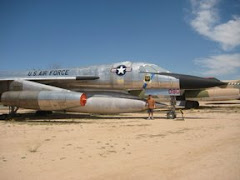
F-106A #59-142

During the Cold War, as I've written, there were, in a few places in Washington, Air Bases with interceptor squadrons assigned. A standard thing to do in the military is to train until an action becomes automatic. These interceptor squadrons were here for a few reasons. One was the presence of several War-Making industries (i.e., Hanford, Boeing, a few large naval bases, and any number of raw materials, like aluminum, wood products, and so on), the other was Washington's geographical placement. Washington is the first state on a route from the Soviet Union to other points in the USA (We don't claim singular status there, but you would get to us before you got to, say, Nevada on a flight from the Soviet Union).

Early training for interceptors usually involved a friendly bomber training for their own mission and the interceptor training for his and the two meeting up at some point. Ground control would vector the interceptor to a point where either the interceptor pilot (F-51s) or his on-board radar (F-94s,F-86s, F-89s, and finally F-106s) could track the incoming bomber on his own. Well, sometime in the late 1950s someone in the USAF decided to begin using the Martin B-57 Canberra to test the air defenses of the US. They decided to use the B-57 because of its size, range, speed, and altitude capability.

The B-57 did this, at first, without any special additions. No electronic gadgets or anything. But, as the interceptors got better at their jobs, the USAF decided to modify several RB-57As (R standing for reconnaissance)to do the job better. They added several black boxes and chaff dispensers and viola! they had a good target. These became part of Defense System Evaluation Squadrons. Eventually, though, B-57Bs and B-57Es were also modified accordingly. The EB-57s were used for many years to test the air defenses of the US. In fact, the last of the type to operate for the USAF were EB-57s, the last of which were retired in 1982.

The F-106 was basically an F-102 up-engined and integrated with a fire control system. The external differences between the two are easy for most to discern. The F-106's air intakes were moved behind the cockpit and the vertical stabilizer was chopped off compared to the F-102's. The first F-106 rolled off the assembly line in 1956. The last one was retired in 1988! Relatively unheard of, as compared to siblings like the F-104 and F-105, it stood guard at home while the others went off to war in Vietnam. Though, it did deploy to forward bases like Korea and Labrador (Though, one wonders how a TDY to Labrador, Canada compared to one to Korea).

Sometime during the afternoon of August 27, 1963, First Lieutenant Roger C. Axlund of the 498th FIS, began his flight planning routine for a night ECM/ECCM intercept training mission against an EB-57E (According to the accident report, it was a TB-57E, though the B-57 did not have a training variant. The B-57E had dual controls and was sometimes used for training and was hence designated a TB-57 in those instances. And some referred to it as a TB-57 at all times. Because it was being used as a defense system evaluator, it will be referred to as an EB-57 here.) temporarily deployed to McChord AFB, Washington from Hill AFB, Utah.

Lieutenant Axlund would likely have been taken out to his aircraft about an hour before launch. He was assigned to F-106A #59-142 and took off at 0005 on August 28, 1963, with two+ hours worth of fuel. The EB-57 had departed McChord AFB at five minutes before midnight with 4+ hours of fuel.

SAGE (Semi-Automatic Ground Environment, a kind of Air Defense Ground Control) conducted the approach. Both the B-57 and the F-106 (Six) were in contact with the SAGE controller. The B-57 was communicating with voice comm, while the six was using a data-link (only mandatory safety and intercept calls were made by voice). Weather was clear, visibility was six miles in smoke.

The mission had been fully briefed between the crews of the Sixes and the B-57, since the ECM equipment in the EB-57 was new to the ADC training inventory. The B-57 turned on all of its jammers (four in number) until one of the generators failed, so the crew turned off the forward two jammers. This would be no problem since all of the attacks were expected to be from the aft quarters. There were two F-106s up conducting intercepts, alternating attacks. The B-57 maintained 250 KIAS (Knots Indicated Air Speed) and headings as directed by the SAGE controller.

Axlund called two successful attacks to the SAGE controller, even though there was non-standard language used. Axlund had reported no malfunctions or deficiencies. He made another visual contact on the B-57 and called separation on and visual contact with the other F-106. He then called a lock-on to the ECM jamming source. He en continued to attack the ECM Jamming source and collided with the B-57. The six's vertical stabilizer hit the B-57's number one engine (Left) and the six continued on from under the B-57's wing. The top 52 inches of the vetical stabilizer separated from the F-106.

The B-57 reported the collision to the SAGE controller and turned back toward McChord, about 95 miles East. The collision occurred at 0109 local, at 47 degrees 43 minutes N. , 124 degrees 45 minutes West. This was approximately 15 miles off shore, due West of Destruction Island, Washington.

Axlund was observed flying straight and level for about a mile, when he began a gentle left turn. He did not transmit after he reported the ECM lock-on. About three minutes prior to the collision. The UHF antenna was destroyed in the collision. The other F-106 had Axlund in sight and watched him begin and accelerated descent, seemingly stabilized on a heading toward shore. Axlund's aircraft began to pitch down and increased speed, in the opinion of the Six observing him, into the trans-sonic region. Somewhere under 20,000 feet, the observer saw a flash from Axlund's aircraft, which he took to be an ejection. Immediately after that, he lost radar an visual contact with Axlund's plane.

The B-57 returned to McChord safely. The crew was uninjured, though the pilot had to shut down his number one engine due to fire/overheat indications.

It appears, from this partial report, that Axlund was never located. One suspects wreckage from the aircraft was picked up, since the exact measurements of the lost vertical stabilizer appears to be known.

The track on the map that came with this partial report shows that the intercepts were conducted from the North Western tip of Washington down to about even with the Kalaloch area, where the collision occurred. The left and right elevons appear to have drifted quite a ways, having been located somewhere in the vicinity of Grays Harbor. The hand drawn map appears to have been copied several times and is of poor condition.

As ever, there seems to be very little information here. I know there is more out there. I would like to search newspapers from the era and area to see what they say, but my time and money are always in demand elsewhere. If ANY of you reader have something to add, PLEASE feel free to do so! Do it in a comment or e-mail me. I will do my best to publish it if you request it!

There are a few questions that rise here: What caused Axlund to misjudge the distance between him and the B-57? His aircraft was armed with training missiles. The F-106 had no guns, so getting THAT close to another aircraft when not refueling or flying formation seems unwise at best. Did Axlund suffer oxygen deprivation? Why else would he have gotten that close and not avoided a collision? There are several cases that support the stability of the Six in un-piloted flight, which would seem to support his not being conscious just prior to the collision.

You can see a picture and history of #59-0142 here.

Sources:
Accident report, electronic document, for #59-142.
B-57 Canberra In Action, Squadron Signal Publications. by Jim Mesko.

Saturday, September 19, 2009

Washington Treasure!

The State of Washington has a long history tied to aircraft. In WWI, Washington spruce wood was used in many an airplane. In WWII, Washington had the cheap power needed to process and smelt aluminum. The Boeing company began its life here. During WWII numerous local airfields were home to Army Air Corps training bases.

Washington is/was also home to Microsoft...Paul Allen, one of the duo who founded Microsoft, despite having obscene amounts of money, has a very real and admirable interest in aviation. His generosity is shown in the sharing of his growing collection with the public. It is greatly appreciated. His museum is the Flying Heritage Collection, in Everett, Washington.

This collection is full of rare and prized WWII aircraft. Each of the great powers is represented.

England:
Spitfire
Hurricane
Avro Lancaster (Nose)

USA:
P-40
P-47
P-51
F6F
JN4 Jenny (WWI)

Japan:
A6M Zero
Ki-43 Oscar

Germany:
Me-109
Me-163
FW-190
Feisler Storch
Buzz Bomb (V-2)
Manned Buzz Bomb
2X Flak guns! (88mm)

Soviet Union:
IL-16
PO-2

All in all, it is a great collection. The Me-163 is worth the small price of admission, which is only $12.00. (I feel like I am really talking this place up, and I want to find something wrong with it...nah, I can't really find anything wrong with it.)

Messerschmidt Me-109

Genera view of collection below.
Grumman F6F below
The Japanese Army did not use the A6M Zero, they used a similarly light and agile aircraft, the Ki-43 "Oscar."
The nose section of an Avro Lancaster, called the Lanc by its crews.
The minuscule Me-163 Komet, a rocket powered aircraft with an eight minute powered flight time. It was the fastest operational aircraft in WWII. As for the small propeller, I have been told, somewhere in the distant past, that it was used to drive the generator for electrical power.
The wheeled dolly dropped off as soon as it was airborne, it landed on the skid on its belly.
Below are both of the V-2s.
The Japanese Navy used the A6M to great advantage in the first few years of the war, but the Americans soon discovered its weaknesses. Below we have one of the few surviving examples...still undergoing restoration by the look of it.
This is another prize of the collection (the other is the Me-163, in my humble opinion), a Focke Wolfe Fw-190! Long nose.
The newest arrivals: Flak guns!! The German 88 bomber crews SO hated.
Another photo of the Me-109.
The nose of the P-40. (I gotta say, I like this photo)
The Hawker Hurricane.
The little Soviet fighter that could, the Il-16.
The Spit. Check out that Rolls Royce!
Yet, another photo of the Me-109!
The P-51.

The P-47...is the sleekness of the P-51 obvious here?
Look at all the places a P-47 can leak...I don't care how fast the P-51 could go, the old Jug is still my favorite. I think it might be the fact that it carried eight (8) .50 caliber machine guns...the P-51 only carried six...


After the Flying Heritage Museum we drove up to the Boeing Restoration Center. It is a really laid back facility. Tools and aircraft parts were everywhere. This is a working facility here but I could have spent hours there just ogling the pieces of history all over the shelves! Have a look.

Below is a very rare jet indeed! A Vought F7U Cutlass...better known to her pilots as the Gutless.
below is an Antonov An-2 Colt.
In one hangar there were just engines on shelves...tons of engines!
an F-8 Crusader!
Another view of the F7U.
And the Feiser Storch of the FHC! It took off in less than 200 feet, and landed in roughly the same distance...or less.


There are a few more museums in Washington, I hope to post on all of them eventually.

Also at Paine Field is the Storm Birds Hangar where they are building NEW Me-262s!

Sunday, September 13, 2009

C-133 Last Flight

Last Flight of the C-133 Cargomaster from INVERSION on Vimeo.

So, I was not privy to the last flight of a C-133 at the time. I have since spent too much time in mourning of that lost chance to see a C-133 in flight. It flew from Alaska to McChord AFB to Travis AFB. I would have seen her at McChord...but I did not. She is now set to become a display in remembrance of the many, many crewmen that flew her to keep the necessities of life flowing from one part of the globe to another. She will be a permanent display at the Jimmy Doolittle Museum at Travis AFB in California.

Honestly, I cannot wait for the DVD to come out...I will SOOOOO BUY IT!

I have had a few comments from veterans who partook in Exercise Coulee Crest. C-133s figured prominently into the build up of armed forces during that exercise. C-124s also were used to transport essential equipment. At least one commenter, thank you sir, noted that C-133s stopped at Larson AFB, in Moses Lake, Washington. This commenter had checked his father's log book to confirm it. It is that kind of effort from readers that makes this site work. Thank you!


Tuesday, September 1, 2009

64 years...again!

September 2, 1945. War ends. Deck of the USS Missouri. I have been there and seen the spot. I can only imagine the way it was 64 years ago...here is a picture, shamelessly stolen:

Saturday, August 22, 2009

CH-54

Put Out The Fire!


We had some thunderstorms the other day. There were a few lightning strikes. Eastern Washington being a desert, these resulted in fires. I took a drive and took some pictures while investigating the smoke. Apparently fires started in 5 locales, all about 25-30 miles east of us. By Friday afternoon the firefighters had put out two.

One said they had had two choppers dumping water, but a third from some other showed up and was not responding to the on scene commander. So, air control had grounded all aircraft.

This evening we heard a noise out the font door. I stepped out and found this. It is headed in the direction of the fires. (they are still burning, we could still see the smoke today.) It is a CH-54 Tarhe, also known as the Skycrane. There are still several in flying condition and many are owned by a firm in Corvallis, Oregon. I was nowhere near enough to see its tail number or registration number. Suffice it to say, it's cool to see one in the area. There you have it.
and then we went for a walk about an hour later. As we were getting home we heard that sound again...I had the camera ready as it flew past us into the sunset.

Friday, August 14, 2009

August 15, 1945

A couple months ago, I acquired this newspaper. most fascinating, isn't it?

Sixty-four years ago, this is what was in our local newspaper. Note the sinking of the Indinapolis was no small story. Still, in the lower part of the page is a story that is of interest to me and you and anyone else tht reads this site. See, to the lower left? Where it says "Navy Flier Dies In Valley Crash?"


Now, I am still awaiting the accident report from the Navy, but they are, apparently, in the midst of a move and it may be awhile before the files I have requested can be sent to me. Still, it is an interesting find, don't you think?